Category: Valet Trash Service

Valet Trash Service

Holiday Trash Volume in Apartments: How to Plan for the Spike

Apartment waste volume rises sharply from mid-November through the first week of January, concentrated in three waves: Thanksgiving week, the week before Christmas, and the New Year’s cleanup week. The spike shows up most in cardboard and bulk items, which fall outside valet trash service and land directly on your dumpster hauler and your maintenance team. The properties that get through December without overflow photos reaching ownership are the ones that coordinated with their hauler by the first week of November — not December 15, when the hauler has already set its holiday routes.

This piece covers the planning timeline, the hauler coordination checkpoints, the scope line between what valet trash handles and what your dumpster takes, and the resident communication cadence that reduces non-compliance during the one period of the year when it matters most.

What’s actually driving the spike?

Three overlapping waste streams, hitting at different times.

Cardboard and packaging starts rising in late October with early online holiday shopping and compounds through December. By mid-November, most multifamily properties see 2–3 times normal cardboard volume at the recycling area or dumpster. This stream is the most visible — flattened boxes stack visibly, unflattened boxes consume dumpster space fast — and the most preventable with resident communication.

Food and entertaining waste rises during the three to four days before each major holiday and the two to three days after. The volume increase is real but modest — maybe 15–25% on peak days — and it hits the valet trash stream rather than the dumpster. This is the part valet trash absorbs if the service is running normally.

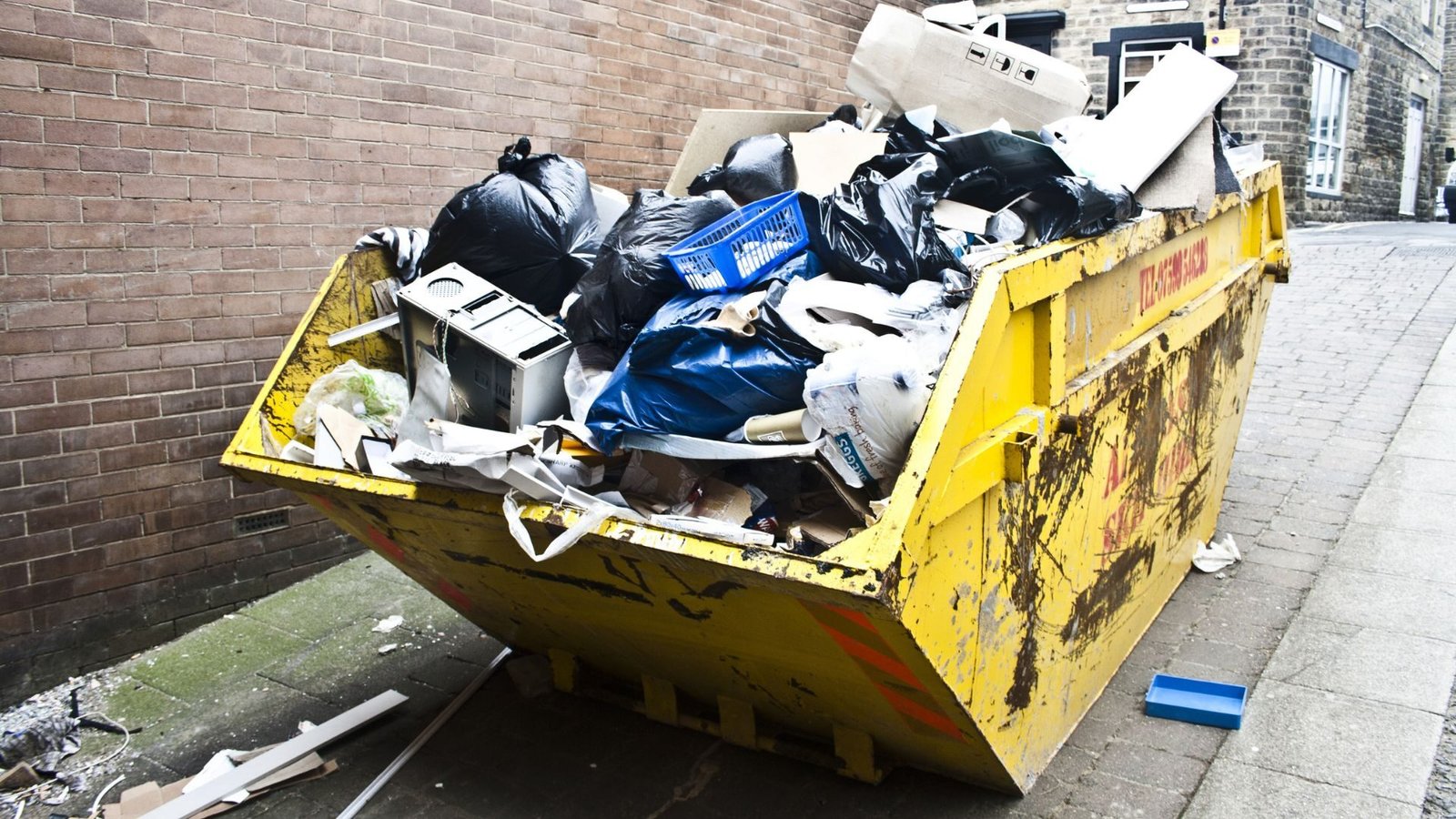
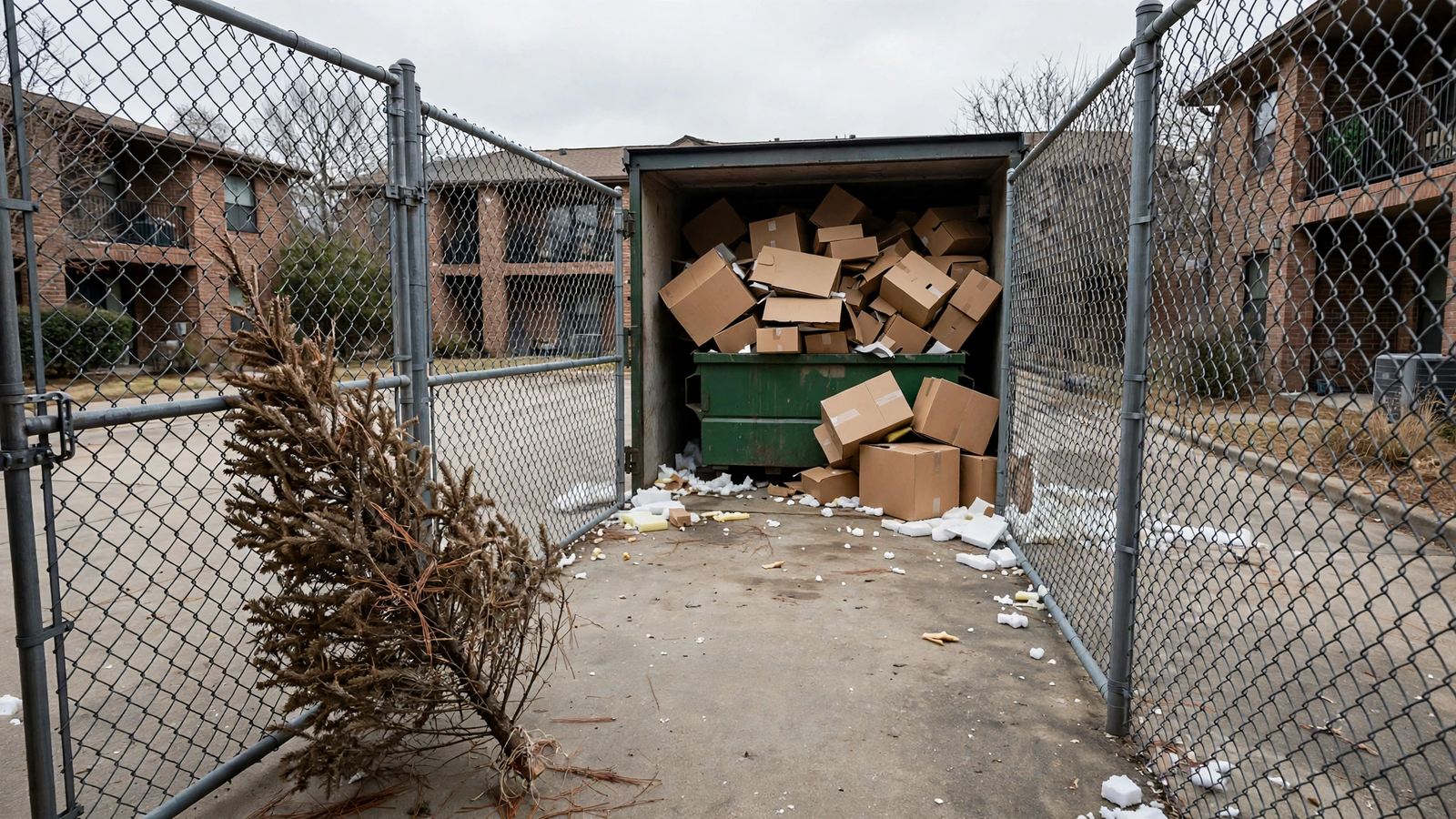
Seasonal bulk items are the dangerous category. Christmas trees, broken ornaments, holiday décor, packaging foam from large gift items, and the shipping boxes that didn’t fit the recycling bin all appear in dumpsters within a 7-day window in early January. This is the surge that causes overflow photos. It arrives after most property teams have mentally moved past the holidays, which is why it’s the most common cause of January complaints.

Why does the valet trash service get blamed for the dumpster problem?

Residents don’t distinguish between your valet trash contract and your dumpster hauler contract. They see trash sitting around, and the vendor whose logo is most visible — the valet trash crew they see nightly — becomes the vendor they complain about.

In practice, your valet trash service handles bagged household waste from unit doors. It doesn’t handle bulk items, Christmas trees, large boxes, or anything that doesn’t fit the bagged-waste scope. Those go to your dumpster and are the responsibility of your hauler contract.

This matters during holiday planning for two reasons. First, increasing valet trash service doesn’t solve the real holiday overflow problem, which is dumpster capacity. Second, if your valet trash contract starts getting blamed for January overflow, the issue to raise with the vendor is scope clarity in resident communication — not service failure.

For a full breakdown of what sits inside and outside the valet trash scope, see our piece on where the service scope line sits.

The 6-week planning timeline

Published early October to give you time to run it. The hauler-coordination deadlines are the ones that can’t slip — if you miss them, you’re paying emergency-service rates in December.

Planning timeline running from early October to early January. Hauler deadlines are the hard dates; everything else has some flex.
Week Primary task Deadline-sensitive?
Week of Oct 13 Pull last year’s dumpster overflow log, hauler emergency-pickup invoices, and resident complaint records from Nov 15 – Jan 10. Identify peak days and peak categories. No — but if you don’t do it now, step 2 is a guess.
Week of Oct 20 Project this year’s volume. Conservative baseline is 25–40% above normal for peak weeks, concentrated in cardboard and bulk. Occupancy change versus last year adjusts the number proportionally. No.
Week of Oct 27 Contact your dumpster hauler. Request increased frequency for Thanksgiving week, the week of Dec 22, and the week of Jan 5. Get the frequency change in writing, with the cost delta stated. Yes. After Nov 7, most haulers can’t adjust routes.
Week of Nov 3 Confirm hauler holiday schedule and any route adjustments. Order a temporary roll-off if last year’s data shows you’ll need overflow capacity in early January. Yes. Roll-offs for early January book 6–8 weeks ahead.
Week of Nov 10 Resident communication #1: pre-Thanksgiving. Cardboard flattening, where to put bulk items, what the valet trash service does and doesn’t take. Soft deadline. Post-Nov 20 is too late to shape Black Friday delivery behavior.
Week of Nov 24 Daily walk of dumpster area starting Monday. Note what’s going wrong — the Monday after Thanksgiving is a preview of Dec 26 and Jan 2. No.
Week of Dec 1 Resident communication #2: pre-Christmas. Repeat the cardboard and bulk guidance. Add Christmas tree disposal instructions if your property allows them. Soft deadline.
Week of Dec 15 Confirm hauler is still on the increased schedule you booked in October. Confirm your temporary roll-off delivery date for January. Operational. Catches hauler scheduling errors before they become January overflow.
Week of Dec 29 Resident communication #3: post-Christmas. Tree disposal, box flattening, where bulk items go, when the roll-off arrives if you ordered one. Hard deadline. Send Monday Dec 29 at latest.
Week of Jan 5 Daily walks of dumpster and recycling area. This is the peak week. Document everything you’d want to improve for next year. No.
Week of Jan 12 Review. Hauler invoice total, emergency pickup count, complaint count, overflow photo count. File it with the Oct 13 data for next year. No.

What resident communication actually works?

Three messages across the six weeks: pre-Thanksgiving, pre-Christmas, post-Christmas. Short, specific, and tied to a visible place where the resident makes the disposal decision. Property-wide emails get skimmed; a flyer at the dumpster area and a lock-screen notification on pickup nights get read.

Content that matters:

  • Flatten cardboard before placing it in the recycling area. An unflattened box fills five times the space of a flattened one. This is the single highest-leverage behavior change.
  • Where bulk items go. Named location, named day. If bulk items go to the dumpster, say so. If they require a scheduled pickup, say that with instructions.
  • What the valet trash service does not take. Christmas trees, large boxes, broken furniture, packaging foam. Scope clarity here prevents complaints that your valet service failed when it was never asked to handle those items.
  • Christmas tree disposal. If your city or hauler offers tree collection, give the date and location. If not, say what residents should do instead.
  • When the dumpster area will be at capacity. Honest expectations outperform cheerful ones. If Dec 26 and Jan 2 are the two days the area will overflow, say so, and name when extra service is scheduled.

This runs on the same compliance principles as everyday valet trash rules. More on that in our piece on why residents ignore valet trash rules and what actually fixes it.

What your maintenance team should be doing differently

Four changes to the normal routine, running from Nov 15 through Jan 10.

Daily dumpster area walk-through. Not a weekly inspection. Daily. Photograph anything unusual. The photo log becomes your evidence file if you need to escalate to the hauler for missed pickups or request emergency service.

Faster response to overflow. A bag outside the dumpster for one day becomes a pile for two days. The threshold during holiday weeks is “clear within 2 hours,” not “clear within 24.” If your maintenance team is already stretched, this is where you temporarily reassign porter hours from lower-priority tasks.

Separate pile for bulk. If your property doesn’t have dedicated bulk collection, designate a specific spot — ideally fenced or screened — for bulk items between Dec 26 and Jan 5. Trees, boxes, packaging foam go there and get hauled in one batch rather than filling the regular dumpster.

A written log of extra hauler service. Every emergency pickup, every schedule change, every charge. This becomes your negotiating leverage at renewal and your reference data for next year’s planning.

What this costs, roughly

Three cost increases to budget for, in order of magnitude.

The largest is incremental hauler frequency. Depending on your contract, one extra pickup per week during peak weeks typically runs 25–60% of a normal weekly rate per extra pickup. Over the 6-week peak period, that’s a real line item, and it’s most of what you’re spending on holiday waste management.

Second is any temporary roll-off container, which runs a fixed delivery, rental, and haul fee — often $400–800 for a 1–2 week placement, depending on size and market.

Third is incremental maintenance labor, which is usually absorbed into existing porter hours unless the property is already understaffed. If you’re redirecting porter time to dumpster monitoring, something else gets deprioritized. Decide in advance what that is.

Your valet trash contract rate shouldn’t change for the holidays. For context on how the per-door rate and billing basis are structured, see our valet trash pricing guide., because the scope doesn’t change. If your valet vendor proposes a holiday surcharge for handling bulk items, that’s a scope expansion request — treat it as a separate quote, not as part of the recurring contract.

What goes in next year’s playbook

The January 12 review week is where you make this easier for next year. Three questions to answer in writing:

What did we spend on hauler service above baseline? This becomes next year’s budget line and tells you whether to negotiate an annual holiday-adjusted contract instead of ad-hoc requests.

What were the three worst days? Overflow photos, complaint volume, and visible failures. Next year’s plan concentrates resources on those three days specifically.

What communication worked? Which notice reduced which problem. If the pre-Christmas cardboard reminder dropped unflattened boxes measurably, that message gets sent earlier next year.

A holiday waste plan is iterative. The first year documents the baseline. The second year addresses what the first year surfaced. By year three, the January 2 dumpster area looks the same as the June 2 one, and that’s the real success criterion.

Planning your property’s holiday waste coverage?

Verdant provides valet trash, trash-out, and bulk-removal services across the Dallas–Fort Worth metroplex. If your current valet service is being asked to handle work outside its scope, or you need bulk removal to supplement your hauler during peak holiday weeks, we can quote the add-on without disrupting your existing contracts.

Request a quote or call 888-520-0340.
Valet Trash Service

Five Reasons Property Managers Cancel Valet Trash Contracts (and How to Avoid Repeating Them)

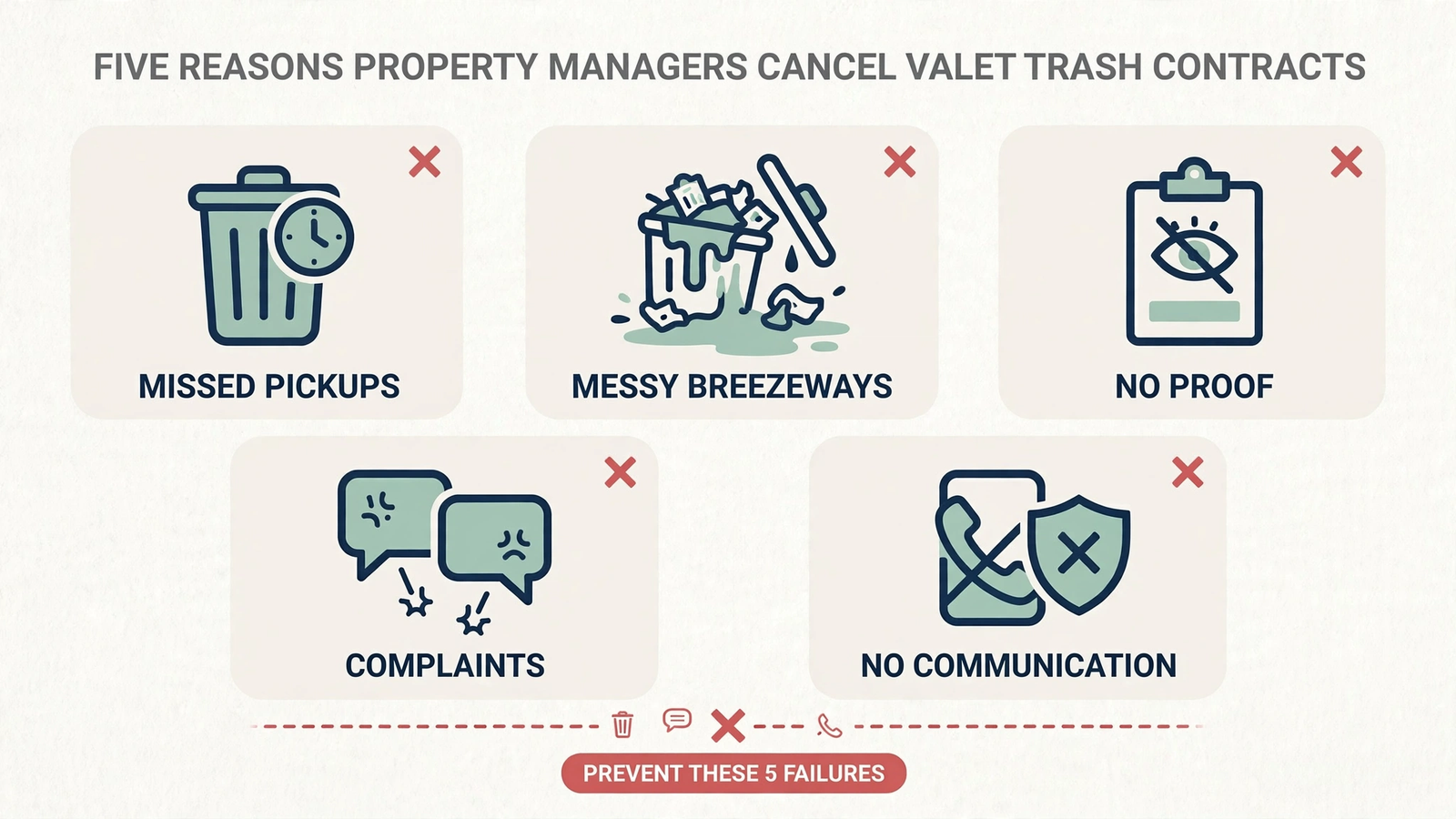
Property managers cancel valet trash contracts for five reasons, and none of them is the one they name on the way out. The stated reason is usually a single missed night or an angry resident email. The real reason is a pattern the vendor didn’t fix, a term the property never should have signed, or a cost that quietly stopped paying for itself. This piece walks through what actually fails, how to check for it before your next contract, and when cancellation is the right decision versus when it just moves the same problem to a new vendor.

Written for the property manager side of the table. If you’re weighing whether to renew, cancel, or rebid a valet trash contract, this is the diagnostic.

How do valet trash contracts actually fail?

They rarely fail in one moment. A contract that gets cancelled has usually accumulated three or four unresolved patterns over six to nine months, until a single event — a corporate reviewer walking the property, an owner complaint, a resident review that goes viral inside the leasing office — makes the pattern visible enough to act on.

The event isn’t the cause. The pattern is. Which is why replacing a vendor without understanding the pattern often puts the property in the same position six months later, with a new logo on the invoices.

The five patterns below account for almost every cancellation we’ve seen or heard about across DFW multifamily.

Reason 1: Missed pickups that stopped being outliers

Every valet trash vendor misses a night occasionally — a truck breaks down, an attendant calls out, a route runs long. That’s tolerable. The pattern that isn’t tolerable is when misses become weekly, cluster on the same nights, or hit the same buildings within your property.

What you’re actually observing when this happens is a route problem the vendor hasn’t solved: understaffing, driver turnover, or a route that grew past what one attendant can cover in the pickup window. The vendor knows. They usually hope the property doesn’t notice.

What to check before signing the next contract: ask for written missed-service credits. Not a phone commitment. A clause in the contract that says: for every missed night, the property receives a credit at a defined rate per door, applied to the next invoice, without the property having to submit a claim. If the vendor won’t put that in writing, they know their reliability is a risk.

What to check while your current contract is still running: log every missed night for 60 days. If misses correlate to specific nights, buildings, or attendants, the vendor has a structural problem, not a bad-luck problem.

Reason 2: Issues get acknowledged, not resolved

You email the account manager. They apologize, promise it won’t happen again, and ask you to give the team a chance. It happens again the next week. You email again. Same response. This is the second-most-common failure mode, and it’s the one property managers underestimate because each individual exchange feels polite and productive.

The test isn’t whether the vendor responds. It’s whether the response is followed by measurable change. A corrective plan with a date, an owner, and a checkpoint is a resolution. “We’ll talk to the team” is an acknowledgment. Confusing the two is how contracts die slowly.

What to check before signing: written response-time commitments and an escalation path. Under 4 hours for acknowledgment, 24 hours for resolution or a written plan, and a named escalation contact above the account manager. Absence of any of these means you have no recourse when issues stall.

What to check while running: pull the last three months of your email thread with the account manager. Count how many issues have a specific resolution date attached versus how many end with “we’ll get on it.” If the ratio tilts toward the second, the contract is drifting toward cancellation.

Reason 3: Complaints piling up faster than the vendor addresses them

Individual resident complaints about valet trash are inevitable. The question is what’s underneath them, and whether the vendor is treating each complaint as an isolated apology or as data.

Complaints that cluster around specific rules — the pickup window, prohibited items, bag placement — usually trace to a communication or rules problem, not a vendor problem. Complaints that cluster around specific nights or buildings usually trace to route or staffing problems. Complaints that cluster around resident conduct — bags left out too early, non-compliant items in the stream — trace to a compliance system the property hasn’t built.

The vendor should be able to tell you which cluster your complaints fall into. If they can’t, they’re not tracking them, and they’re addressing symptoms one by one until you get tired of forwarding them.

What to check: ask the vendor for a monthly summary of complaints broken down by root cause. If they don’t produce one, you’re the one doing the tracking, and you’re the one making the case for cancellation without vendor data. That’s a fixable ask: any reasonable vendor can start tracking this if you require it.

Reason 4: The property doesn’t look the way the contract promised

Bags visible outside doors during daylight hours. Corridor floors stained from leaking bags. Overflowing dumpster surrounds on Monday mornings. Prohibited items sitting where the valet crew left them because they can’t be lifted safely.

These are the visible failures. They matter because they’re what your regional manager, your owner, and every prospective resident sees when they walk the property. A contract can be technically performing — every scheduled pickup completed on time — and still be failing because the definition of “pickup completed” was too narrow to protect appearance.

What to check before signing: whether the base scope includes handling of non-compliant items (typically it doesn’t, and needs a written add-on process), whether the vendor’s crew sweeps the pickup area or only the bags, and what “completed pickup” means for a bag that leaks or an item that’s prohibited. Get the definitions in writing.

What to check while running: walk the property at 7:00 a.m. on a pickup morning, before the office opens. Not the front entrance — the interior corridors, the trash rooms, the dumpster surrounds. If what you see doesn’t match what the contract promised, you have your evidence.

Reason 5: The math stopped working

The one nobody talks about. A contract can be running smoothly and still get cancelled because the numbers changed. Occupancy dropped, the resident fee stayed the same, the vendor rate escalated at renewal, and the net revenue from the program quietly went to zero or negative.

This is a specific failure mode of contracts written on a total-units basis rather than an occupied-units basis. We covered the math in detail in our valet trash pricing guide — the short version is that below roughly 85% occupancy, a lower total-units rate can cost more than a higher occupied-units rate, and property managers usually don’t run this check until the annual budget review surfaces the gap.

What to check before signing: whether billing is on total units or occupied units, and what the escalator is at renewal. A 3% annual escalator on a total-units contract while your occupancy trends down is a compounding problem.

What to check while running: pull your current per-door cost, your current resident amenity fee, and your current occupancy. If (occupancy × fee) is trending toward (total units × rate), the program isn’t paying for itself and cancellation may be the right answer — but not for the reasons anyone will state.

When is cancellation actually the right call?

Three conditions.

The same failure repeats after written escalation. Not verbal escalation, not an email chain — a written, dated escalation letter that names the specific pattern, references the contract clauses being breached, and requires a corrective plan. If the vendor either won’t produce a plan or produces one and misses its own checkpoints, cancellation is defensible and often the only option.

The vendor can’t demonstrate improvement with data. A vendor asking for another chance without complaint trend data, missed-pickup logs, or a specific corrective plan is asking you to trust that things will change on faith. Six months of the same faith request is the pattern that produces cancellation.

The math no longer works. If the fully loaded cost of the program exceeds the resident amenity fee at your current occupancy, the program isn’t paying for itself and it isn’t going to. Renegotiating to an occupied-units basis is worth trying first. Cancellation is the fallback.

When cancellation is the wrong call

Three conditions on the other side.

The problems trace to your compliance system, not the vendor’s execution. If most complaints are about residents leaving bags out early or putting prohibited items in the stream, that’s a rules and enforcement problem the property owns. Changing vendors doesn’t fix it. We covered this in our piece on why residents ignore valet trash rules.

The contract terms are the failure. If your total-units contract is bleeding money at 74% occupancy and the vendor is meeting every operational commitment, cancelling and rebidding gets you the same math from a new vendor. Renegotiate the terms instead.

You haven’t given a written escalation. A cancellation that follows only verbal complaints often surprises the vendor, and it usually costs the property leverage on any refund of prepaid fees, transition period, or missed-service credits already owed. Written escalation first, cancellation second.

What to do before you sign the next one

The failure modes above are almost all avoidable at signing, if the contract is written to catch them. A short list to negotiate before you sign, in priority order:

  1. Billing basis. Total units or occupied units, with the definition in writing. This moves your effective cost more than the headline rate.
  2. Missed-service credits. Automatic, per-door, applied to the next invoice, with no claim required.
  3. Response-time and resolution commitments. Under 4 hours for acknowledgment, under 24 hours for a written corrective plan when the issue is systemic.
  4. Escalation path. A named contact above the account manager, in the contract.
  5. Scope of “completed pickup.” Including how non-compliant items are handled and whether the crew sweeps the pickup area.
  6. Rate escalators at renewal. Capped, and tied to a specific index rather than “market rate.”
  7. Termination clauses. A cure period that lets you exit if written escalations aren’t resolved, without penalty.
  8. Three DFW references from properties the vendor has served for at least a year. Call them.

Most cancelled contracts failed on terms that were negotiable at signing. The next contract doesn’t have to fail the same way.

Reviewing your valet trash contract?

Verdant provides valet trash service across the Dallas–Fort Worth metroplex. Send us your current terms and we’ll walk through them with you — no obligation, no pressure to switch. If the math or the terms don’t work, sometimes the best answer is a renegotiation with your existing vendor, and we’ll say so.

Request a quote or call 888-520-0340.
Valet Trash Service

Why Residents Ignore Valet Trash Rules, and What Actually Fixes It

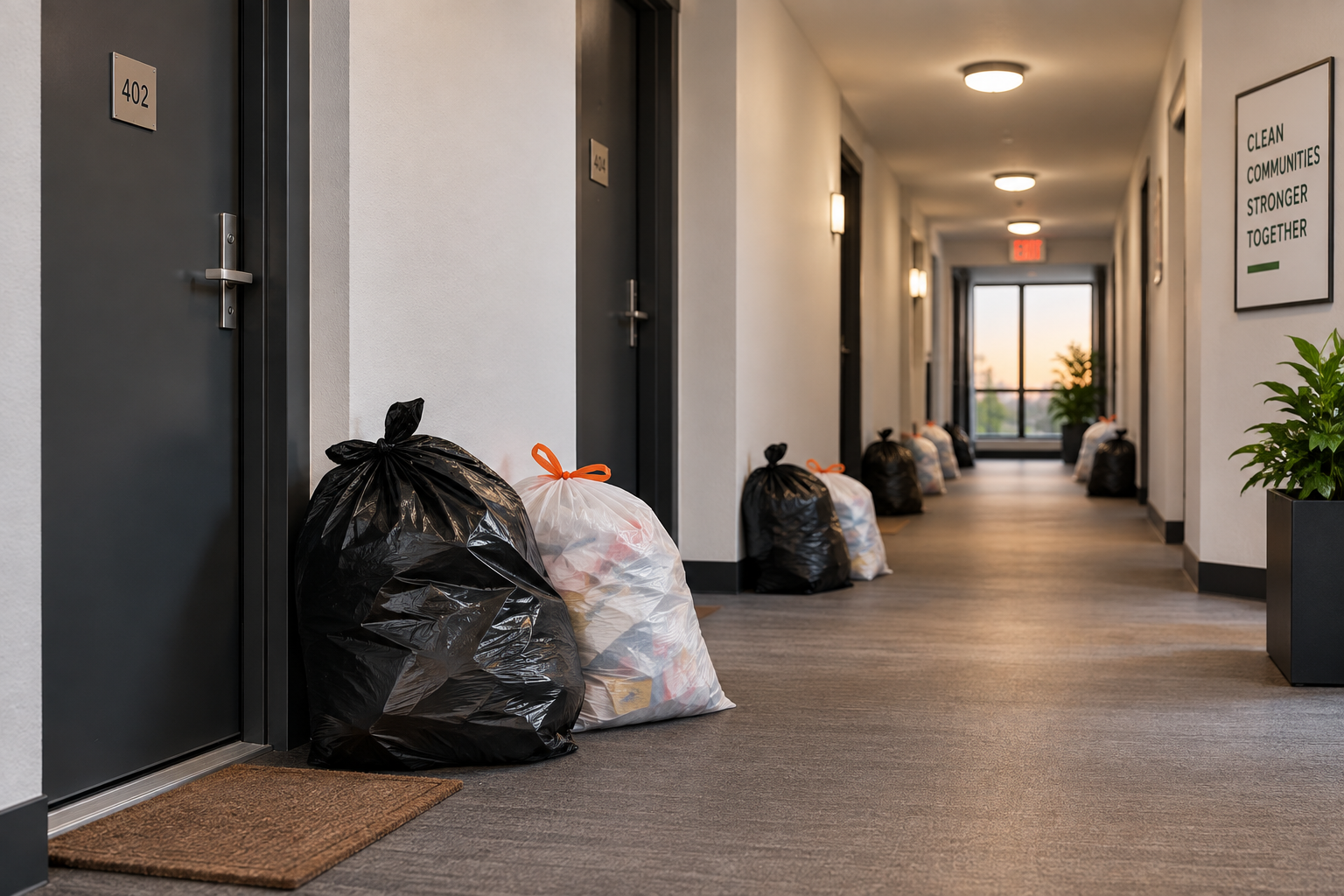
Most valet trash violations aren’t a resident problem. They’re a system problem. Bags placed at the wrong time, prohibited items in the stream, corridors staying messy — these are almost always symptoms of rules that were unclear, inconvenient, unexplained, or unenforced. Fixing the system resolves more violations than penalties do, and it’s the single biggest lever a property has for keeping a valet contract from getting quietly cancelled at renewal.

This piece explains the real drivers of non-compliance, why more emails don’t work, and the enforcement ladder that turns chronic complaints into a settled operational routine.

Why does this matter beyond the corridor?

Non-compliance shows up as more than a housekeeping annoyance. Bagged trash sitting out for hours attracts pests and, in the summer, produces the odor complaints that end up in Google reviews. Prohibited items in the stream create disposal-fee surprises that hit the property’s bill, not the vendor’s. Overflowing valet setups violate fire code in interior corridors.

And it costs contracts. Chronic non-compliance is one of the top reasons a property drops valet trash service altogether. The complaint the regional manager hears isn’t “residents are ignoring the rules.” It’s “this service isn’t working.” The rules aren’t the service, but that distinction rarely survives a bad quarter of reviews.

Framed that way, resident compliance is not an on-site cleanliness problem. It’s a contract-preservation problem, and it belongs on the regional manager’s radar.

Why don’t residents follow the rules?

Because the rules assume behavior the environment doesn’t support. Six patterns cover almost every case.

The instructions were never really given. Move-in packets contain fifty pages. Trash policy is on page 34. The resident scanned the first three pages and signed. The rules technically exist. Nobody read them.

The window doesn’t fit real life. Pickup runs 6:00 to 8:00 p.m. The resident works a late shift and gets home at 9:30. Placing the bag “before pickup” means placing it before leaving for work, which the rules also prohibit. Both statements are true and mutually exclusive.

Social proof runs the other way. A resident sees three neighbors leave bags out at 4:00 p.m. Nobody’s been cited. They conclude the rule isn’t real, or isn’t enforced, or is unenforceable. That conclusion is often correct.

The “why” was never stated. A resident asked not to put liquid in bags doesn’t understand it’s because the bag will burst when the attendant lifts it. Without the reason, the rule reads as arbitrary and gets ignored on the specific occasion it feels inconvenient.

Prohibited items were never listed clearly. Cardboard, liquids, hangers, glass, hazardous items, bulk pieces — the resident doesn’t have that list. They put the pizza box out. It doesn’t get taken. They’re annoyed at the service.

Enforcement has been inconsistent. The resident got a warning six months ago and nothing since, despite repeating the same behavior. They’ve learned the warning was a bluff.

None of these describe a bad person. They describe an environment that made the rule easier to break than to follow. The fix is to change the environment.

Why don’t more reminders work?

Because reminders address a memory problem the property doesn’t have. Residents remember. They chose not to follow the rule, and no version of “Please follow valet trash guidelines” changes the reason they made that choice.

Here’s the contrast:

The same rule, communicated two ways. The second doesn’t just repeat the rule — it removes the reasons people break it.
Generic reminder Effective instruction
“Please follow our valet trash guidelines. Bags should be placed out before pickup.” “Pickup is Sunday–Thursday, between 7 and 9 p.m. Bags placed before 6 p.m. attract pests and are the #1 reason residents get fined. If you work late, keep bags inside until you get home — even after 9 p.m. is fine, we’ll get it the next night.”

The second version tells the resident the specific window, the reason the early-placement rule exists, and the alternative for people whose schedule doesn’t fit. It removes three of the six patterns above in seventy words.

Reminders scale. Instructions solve.

What actually improves compliance?

Five system changes, ranked by impact. If you only do one, do the first.

1. A written escalation ladder

The single largest change is making consequences predictable. Residents follow rules that carry consistent, known consequences. They ignore rules that carry inconsistent or invisible ones.

A sample four-step ladder. Fee amounts are illustrative — set yours in line with lease language and any local rules governing amenity fee changes.
Step Trigger Action Documentation
1 First observed violation Written notice with a photo, no fee Attach photo to resident file
2 Second violation, any type Courtesy fee with lease clause cited Photo + citation, chargeback to ledger
3 Third violation Fee doubles; formal note in file Photo, prior notices attached
4 Repeat pattern Lease-level action per the property’s non-compliance policy (see also: move-out trash-out checklist) Full compliance history

Two conditions make this ladder work. It has to be applied consistently across residents — the resident in unit 214 gets the same treatment as the resident in unit 508. And each step has to be tied to specific lease language the resident agreed to at move-in. A ladder invented at the office desk after a bad week won’t hold up.

2. Put the rules where the decision happens

Rules in a move-in packet are not where residents make disposal decisions. Rules on the back of the trash bin caddy, on a laminated card inside the caddy lid, or in the lock-screen notification a resident portal app sends on pickup nights are.

Move the information to the point of decision. That single change reduces friction-driven violations more than any resident newsletter will.

3. Explain the reason, once, briefly

Every rule that survives contact with a resident carries a one-line reason. “No liquids — bags burst when lifted.” “No cardboard — separate recycling stream.” “Bags after 6 p.m. — earlier attracts pests.” When a resident understands why a rule exists, compliance stops being about obedience and starts being about not causing a specific problem they now see.

4. Track violations the way you track work orders

Which rule gets broken most? In which building? On which pickup night? By new residents in their first ninety days, or by long-term residents who have quietly stopped following the rules? Without that data, every intervention is a guess.

A property that tracks compliance patterns can address the actual driver — a new-resident orientation gap, one specific building where the caddies are broken, a pickup window that was fine in winter and stopped fitting when summer schedules shifted. Every one of those is a specific fix. None of them are solved by another mass email.

5. Fix the operational friction

Sometimes the rule itself is the problem. If a large share of residents get home after the pickup window and the property expects strict compliance with a 7:00 p.m. deadline, the property has created its own violation rate. Options include shifting the window later, running two pickup shifts, or explicitly allowing bags out after the window with an understanding they’ll be collected the next night.

Ask the vendor which of these fits their route economics. A minor window change from Verdant’s side can eliminate a violation category entirely.

A 30-day compliance reset

If your community is running a chronic violation rate right now, run this in the next month:

  1. Week 1. Pull the last 60 days of complaints and observed violations. Group them by rule type, building, and time. Look for the pattern that accounts for most of the volume.
  2. Week 2. Rewrite the top violated rules using the “instruction, not reminder” format above. Post them at the point of decision, not just in the portal.
  3. Week 3. Publish the escalation ladder to residents in writing. Not as a threat — as a clarification. Everyone should know exactly what happens at step one and step three.
  4. Week 4. Enforce the ladder consistently for that first week. This is the week the ladder becomes real, and residents update their mental model of what the community actually enforces.

The measurable outcome you’re looking for isn’t zero violations. It’s a repeatable process — a system where the same rule violated twice by the same resident produces the same response, and the property’s regional manager stops hearing complaints scale with the calendar.

Fix the system, not the violation

The compliance problem is rarely the resident. It’s an environment where rules were vague, inconvenient, unexplained, or unenforced — and a resident population that reasonably concluded the rules didn’t really mean what they said.

Communities that fix the system see two changes at once: violations drop, and the pressure to cancel the valet contract at renewal disappears. Both matter, and both come from the same work.

For context on the contract side of the program, see how valet trash is priced in DFW — the billing basis and contract term decisions interact with how much leverage you have on operational changes like window shifts.

Rethinking your valet trash program?

Verdant provides valet trash service across the Dallas–Fort Worth metroplex, including operational support for property teams working through compliance changes. We’ll walk your property, review your current rules, and quote against your actual routine.

Request a quote or call 888-520-0340.

Valet Trash Service

How Is Valet Trash Priced? A DFW Property Manager’s Guide (2026)

Valet trash is priced per door per month, but five factors move that number more than the headline rate does: unit density and layout, pickup frequency, contract length, what is bundled into the base rate, and whether you are billed on total units or occupied units. That last one moves your effective cost more than the rate itself, and most bid comparisons ignore it entirely.

This guide explains how valet trash pricing is built in Dallas–Fort Worth, which variables actually shift a quote, and how to run the occupancy math on any rate you are given.

What is valet trash service?

Valet trash is doorstep waste collection for multifamily communities. A uniformed attendant collects bagged trash from outside each unit’s door on a set evening schedule — most commonly five nights a week, Sunday through Thursday, in a window between 6:00 and 8:00 p.m. — and carries it to the property’s compactor or dumpster.

It does not replace your hauler contract. Most communities run both a dumpster or compactor contract for bulk disposal and a valet trash program for doorstep convenience. Valet trash reduces strain on your containers and creates a billable amenity. It does not eliminate a waste line item.

How is valet trash priced?

Valet trash is priced on a per-door, per-month basis, quoted against your total unit count rather than per pickup or per bag. That single rate is what appears on a bid sheet, which is why bids look easy to compare and usually are not.

Two properties with the same unit count can receive materially different quotes because the underlying cost is labor and route time, not volume. What follows is what actually moves the number.

What determines your per-door rate?

Unit density and property layout

Layout affects a quote more than raw unit count does. A 300-unit garden community with exterior breezeway access lets one attendant cover far more doors per hour than a 300-unit property spread across six detached buildings with interior corridors, elevators, or gated sections. Ask any bidder how many doors per attendant-hour they are assuming for your property. If they cannot answer, they have not walked it.

Property size

Larger properties receive more efficient pricing because setup and drive time are fixed costs spread across more doors. Garden-style communities above 300 units are the most efficient profile in the industry. Smaller condo and townhome communities sit at the other end, where the same fixed route cost divides across fewer units.

Pickup frequency

Five nights, Sunday through Thursday, is the industry standard and the baseline most quotes assume. Adding weekend service, requesting non-standard collection windows, or running seven nights raises the rate because it changes staffing rather than just workload.

What is bundled into the base rate

Bins, doorstep signage, resident compliance materials, and recycling collection should sit inside the quoted rate. When they appear as separate line items, a low headline number stops being low. Compare the fully loaded monthly figure, not the per-door quote.

Contract length

Valet trash agreements commonly run a one-year minimum, with 24- and 36-month terms available. Longer terms usually carry a discount, but they also lock a rate before you know how the service performs at your property. A 36-month term on an unproven provider is a three-year problem.

What contract term decides whether the math works?

The clause that decides your margin is the billing basis: whether the provider charges you on total units or occupied units. Most valet trash contracts apply the monthly cost to the entire property regardless of occupancy.

That asymmetry matters because you pay on every door and bill only the leased ones. At full occupancy the gap is zero. At 88% occupancy on a 200-unit property, you are paying for 24 doors that generate no fee. Over a 36-month term, that gap compounds into a number worth negotiating over.

Ask every bidder one question before you compare rates: is this priced on total units or occupied units? A slightly higher occupied-unit rate can beat a lower total-unit rate outright at anything below roughly 85% occupancy. Most published pricing guides skip this entirely, and it is the most common reason a valet trash line item underperforms its pro forma.

What do residents pay for valet trash?

Residents in Dallas–Fort Worth are typically billed $25 to $35 per month as a mandatory amenity fee written into the lease. That band holds across national benchmarks and appears on lease documents throughout the metroplex, so it is the one number in this equation that is genuinely public.

The spread between what you pay a provider and what you bill residents is your net ancillary revenue. That spread, not the provider rate in isolation, is the figure that belongs in your budget.

At what occupancy does valet trash stop paying for itself?

On a total-unit contract, valet trash goes cash-negative when occupied units multiplied by the resident fee falls below total units multiplied by the per-door rate. The formula:

Break-even occupancy = (per-door rate ÷ resident fee) × 100

Substitute the rate you have been quoted and the fee you plan to charge. The table below runs the model at illustrative inputs so you can see the shape of the curve.

Illustrative model only. Inputs are a 200-unit property, a $12 per-door rate on a total-unit contract, and a $28 resident fee — chosen to demonstrate the formula, not to represent any provider’s pricing. Substitute your own quoted figures. Verdant analysis, August 2026.
Occupancy Occupied units Resident revenue Provider cost (200 doors) Net / month
95% 190 $5,320 $2,400 +$2,920
88% 176 $4,928 $2,400 +$2,528
75% 150 $4,200 $2,400 +$1,800
60% 120 $3,360 $2,400 +$960
43% 86 $2,408 $2,400 +$8

The practical read: for a stabilized DFW asset, valet trash is durably profitable at any realistic rate. The math only breaks on deep lease-up, heavy repositioning, or a property in distress. If you are taking over a 55%-occupied value-add deal, negotiate an occupied-unit basis or a lease-up ramp before signing a long term.

What does valet trash not cover?

Valet trash covers bagged household waste and, in most programs, recycling. It does not cover bulk items. Broken furniture, mattresses, moving boxes, and appliances fall outside virtually every doorstep collection contract, and residents routinely assume otherwise.

That gap is why valet trash and trash-out service are separate line items. Doorstep collection handles nightly volume; trash-out handles move-outs, abandoned units, and bulk. Budgeting one and assuming it absorbs the other is how properties end up with furniture stacked beside the compactor during turn season. Our guide to trash-out services covers what that scope includes.

How should you compare DFW valet trash bids?

Compare bids on five terms, not on the headline per-door rate:

  1. Billing basis. Total units or occupied units. This moves your effective cost more than the rate itself.
  2. Fully loaded monthly cost. Bins, signage, recycling, and compliance materials included, not billed separately.
  3. Missed-service credits. Written credits for missed nights. Without a service-failure provision in the agreement, you have no recourse when nights get skipped.
  4. Staffing model. Whether attendants are employees or subcontractors, and what the provider’s turnover looks like. Route consistency is what residents actually experience.
  5. Bulk handling. Whether bulk pickup is an add-on, and on what terms.

Waste consulting firms that audit multifamily contracts report finding savings in the large majority of cases, with typical overspend in the 20–40% range. Treat that as a vendor’s own claim rather than an independent benchmark, but it is a reasonable prompt to audit an existing contract before renewal. If you are evaluating vendors across several services at once, our onboarding process outlines how consolidated scopes are typically structured.

Is valet trash worth it for a property under 100 units?

For properties under 100 units, valet trash is usually a resident-satisfaction decision rather than a revenue decision. The per-door rate is higher and the total spread is smaller, so the program produces real but modest income — small enough that a single administrative headache can erase the benefit.

The case strengthens when the property has a genuine access problem. If residents walk more than 100 yards to a dumpster, or the property competes in a submarket where neighboring communities already offer doorstep collection, the amenity becomes defensive rather than optional. Smaller communities often get more value from common area cleaning and porter service, where the labor is shared across more tasks.

What else belongs in the same budget line?

Valet trash sits inside a broader property services budget that most DFW operators split across three or four vendors. Consolidating reduces coordination overhead and usually improves per-service pricing. The adjacent scopes are make-ready and unit turns, carpet cleaning and replacement, pressure washing, and interior and exterior painting.

Where does Verdant provide valet trash in DFW?

Verdant Building Services provides nightly doorstep collection across the Dallas–Fort Worth metroplex, including Dallas, Plano, Frisco, Irving, and Arlington. More about our team and service history.

Get a per-door quote for your property

Send us your unit count, layout, and current occupancy. We will walk the property and return a fully loaded per-door rate with the billing basis stated in writing.

Request a quote or call 888-520-0340.
Cleaning Valet Trash Service

How to Find the Right Professional Trash Removal Company for Your Apartment

Proper waste management is crucial for maintaining cleanliness, safety, and convenience in apartment communities. Overflowing bins, pest issues, and resident complaints can quickly arise without an effective system in place. A reliable trash removal partner can prevent these problems by ensuring regular waste collection and proper disposal. This article serves as a guide for apartment residents, property managers, and landlords in selecting the best trash removal provider. By understanding what to look for, you can ensure your community remains a clean and pleasant place to live.

Why a Professional Provider Matters

Choosing a professional trash removal provider offers numerous benefits, including trained workers who ensure consistency and the safe handling of waste. This not only reduces the workload on residents and maintenance staff but also contributes to the overall satisfaction and cleanliness of the community. A reputable Trash Removal Company can prevent the common issues associated with improper waste management, such as unpleasant odors and unsightly messes, which can detract from the quality of living in an apartment complex. Ultimately, the right provider can enhance the day-to-day living experience by maintaining a hygienic environment that reflects positively on the property.

Key Qualities to Look for When Choosing a Trash Removal Service

Reliability & Schedule Consistency

One of the most critical factors in choosing a trash removal service is their reliability and consistency. Ensure the company you select has a track record of on-time pickups with no missed collections. A consistent schedule helps prevent the accumulation of waste, which can lead to overflow and attract pests. Consider asking for references or reviews from current clients to verify their reliability.

Safety & Cleanliness Standards

A professional service should adhere to high safety and cleanliness standards. This means they should have protocols in place for handling waste to prevent contamination and messes. Inquire about their sanitation practices and what measures they take to ensure the cleanliness of the disposal areas. A company that prioritizes hygiene will be diligent in maintaining tidy waste areas, which is crucial for the overall health of the community.

Flexibility in Services

Flexibility is another essential quality in a trash removal service. Look for companies that offer a range of services, such as bulk item removal, recycling options, and special pickups for events or unusual circumstances. This flexibility can accommodate the diverse needs of apartment communities, ensuring that all waste is handled efficiently and effectively.

Local Experience

Experience with local codes, apartment layouts, and resident needs is invaluable. A provider familiar with your area will understand the specific challenges and requirements of waste management in your community. They will be better equipped to navigate local regulations and tailor their services to suit the unique characteristics of your property.

Licensed & Insured Providers

It is vital to choose a trash removal company that is both licensed and insured. This provides protection from liability in case of accidents or damages during waste collection. Ask for proof of insurance and check their licensing credentials to ensure they meet the necessary legal requirements.

Reputation & Reviews

Research the reputation of potential providers by reading online reviews and testimonials. A company with a strong reputation is more likely to deliver dependable service. Look for consistent positive feedback and any awards or recognitions they may have received. A trustworthy service will have a history of satisfied clients and a commitment to customer service.

Affordable Pricing

Transparent and affordable pricing is another key consideration. Be wary of companies that have hidden fees or unclear pricing structures. Request a detailed quote and ensure you understand what is included in the service. A reliable provider should be open about their rates and willing to discuss any additional fees upfront.

How to Match Services to Your Apartment Needs

Different types of apartment buildings require tailored waste management solutions. Whether you manage a gated community, high-rise building, or multi-family housing, it’s essential to understand the specific needs of your property. Ask potential providers about their service plans, including options for after-hours support and amenities like doorstep valet trash. Selecting the ideal Trash Removal Company for Your Apartment can improve the quality of life for residents and reduce complaints, ensuring a more content community.

Red Flags to Avoid

When evaluating potential trash removal providers, be cautious of certain red flags. Poor communication or a history of missed pickups can indicate unreliability. Avoid companies that are unlicensed or uninsured, as this can lead to liability issues. Frequent staff turnover or a lack of training may result in inconsistent service. Additionally, steer clear of providers with unclear contracts or pricing terms, as this can lead to unexpected costs and disputes.

Conclusion

Choosing a professional trash removal service that aligns with your apartment’s needs is vital for maintaining a clean and pleasant living environment. Property managers and residents should take the time to evaluate providers carefully, considering factors such as reliability, safety, flexibility, and pricing. By finding a dependable trash removal partner, you can ensure a cleaner, happier apartment community, free from the usual waste management woes. Take action today to secure a service that will enhance the quality of life for everyone in your building.

Trash Outs Valet Trash Service

Why Professional Junk Removal Saves Time and Money for Property Managers

Property managers often face a myriad of challenges, especially when dealing with abandoned items, bulk trash, and tenant move-outs. These situations not only create clutter but also demand significant time and resources to resolve. Handling junk removal in-house can quickly become a time-consuming and costly endeavor. Maintenance staff might be diverted from their regular duties, leading to inefficiencies and increased operational costs. Enter professional junk removal services—a valuable solution offering speed, cost-effectiveness, and peace of mind. These experts can alleviate the burden on property managers, allowing them to focus on more critical tasks while ensuring that properties remain well-maintained and ready for new occupants.

The Cost of DIY Junk Removal for Property Managers

Attempting to manage junk removal in-house can quickly escalate into a costly and inefficient exercise. When maintenance staff are tasked with removing junk, it often leads to increased labor costs. These employees must be diverted from their regular duties, which can result in overtime pay or the need to hire additional temporary staff to fill gaps in their schedules.

Additionally, the risks associated with untrained staff handling heavy or bulky items cannot be overstated. There is a significant liability involved, as improper handling can lead to injury or damage to the property. This not only increases insurance premiums but also exposes property managers to potential legal challenges.

Moreover, the time spent on DIY junk removal is time lost from more strategic property management tasks. Instead of focusing on tenant satisfaction, lease management, and property improvements, managers find themselves embroiled in the logistics of junk removal. This diversion of resources can ultimately affect the overall performance and profitability of the property.

How Professional Junk Removal Services Save Time and Money

Efficiency & Speed

Professional junk removal services are designed to operate with efficiency and speed. Crews are trained specifically to handle the safe and swift removal of unwanted items. They understand the best practices for lifting and transporting heavy objects, reducing the risks of injury or damage. With their expertise, what might take an untrained team an entire day can often be accomplished in just a few hours, allowing property managers to focus on more critical tasks.

Proper Disposal

One of the greatest advantages of hiring professionals is their commitment to proper disposal. Reputable junk removal services ensure that items are recycled, donated, or disposed of responsibly according to local regulations. This approach not only minimizes environmental impact but also enhances the property manager’s reputation as a responsible community partner.

Reduced Liability

Using licensed and insured professionals significantly reduces the liability for property managers. Should an accident occur during the removal process, the responsibility does not fall on the property management team. Instead, the professional junk removal company assumes the risk, providing peace of mind and protecting the property manager from potential legal issues.

Scalability

Professional junk removal services offer scalability, allowing property managers to address both small clean-outs and large-scale projects with ease. Whether dealing with a single apartment turnover or clearing out an entire building, these services can be tailored to meet specific needs. This flexibility ensures that property managers can maintain a clutter-free environment without overextending their resources.

Improved Property Turnover

Fast and efficient junk removal is crucial for preparing units for new tenants. By partnering with a professional junk removal service, property managers can expedite the turnover process. This results in shorter vacancy periods, allowing for quicker tenant occupancy and improved cash flow. The keyword “Professional Junk Removal service” perfectly encapsulates the value proposition of these experts, as they streamline the process and enhance the overall efficiency of property management operations.

The Extra Value of Same-Day Junk Removal

In urgent situations such as move-outs or emergencies, the availability of same-day junk removal can be a game-changer. This service minimizes downtime and accelerates tenant turnover by ensuring that properties can be promptly prepared for new occupants. The assurance that junk removal can be completed on the same day is extremely attractive to property managers who require fast and reliable solutions. This capability allows for continued operations without disruptions, maintaining the property’s appeal and profitability. By employing same day junk removal services, property managers can respond swiftly to unexpected challenges and keep their properties in top condition.

Why Property Managers Choose Professional Partners

Property managers gravitate towards professional junk removal partners because they provide access to skilled crews equipped with the right tools and expertise. This ensures that junk removal is handled efficiently and safely, without the need to invest in specialized equipment or training for in-house staff.

Furthermore, professional services offer consistent and reliable support for ongoing property needs. This reliability allows property managers to plan and execute their operations without the worry of unexpected delays or complications. The peace of mind that comes from knowing that junk removal is conducted legally and professionally is invaluable, as it allows managers to focus on enhancing tenant experiences and achieving business objectives.

Conclusion

In conclusion, professional junk removal stands out as a more cost-effective and efficient alternative to DIY methods. By leveraging the expertise of professionals, property managers can benefit from significant time savings, reduced liability, and faster tenant turnover. As the demands of property management continue to grow, partnering with trusted junk removal providers is essential for long-term success. Property managers are encouraged to explore these services to streamline their operations and maintain a high standard of property management excellence.

Cut Costs & Risks with Expert Junk Removal

Lifting bulky items, managing disposal logistics, and liability concerns add up—fast. Trust a professional, licensed junk removal partner that handles everything from removal to disposal, reducing your expenses and your risk exposure.

Contact Us for a risk-free, no-obligation consultation.

Valet Trash Service

Apartment Valet Trash Service: How It Works and Why Communities Love It

In the world of multifamily living, waste disposal has long been a source of frustration for both residents and property managers. The sight of overflowing dumpsters, the unpleasant odors that waft through the community, and the safety concerns of walking to a far-flung trash bin late at night are common challenges. These issues not only detract from a community’s curb appeal but can also negatively impact resident satisfaction and retention. But what if there was a better way? Enter valet trash service, a modern and convenient amenity that has quickly become a game-changer. This simple service transforms a daily chore into a hassle-free convenience, offering a solution that improves cleanliness, enhances safety, and elevates the living experience for everyone.

How Valet Trash Service Works

The process of a valet trash service is designed for maximum simplicity and efficiency. It operates on a straightforward, step-by-step system that seamlessly integrates into the daily routine of residents.

  1. Placement: Residents simply bag their household trash, tie it securely, and place the waste bin provided by the service outside their apartment door. This is typically done within a specific timeframe in the evening.
  2. Collection: During scheduled hours, typically five to seven nights a week, a professional, uniformed trash porter arrives at the property. The porter walks a designated route, collecting the bagged trash from each apartment door.
  3. Removal: The collected waste is then transported to the community’s on-site compactor, dumpster, or trash chute. The porter is responsible for properly disposing of the trash, ensuring the bins are neat and the area is clean before leaving.

In many cases, these services extend beyond just trash. Some providers offer separate collection for recyclables on specific nights and may even coordinate with property management for the removal of bulk items, like old furniture, further simplifying waste management for the entire community. The frequency and professionalism of the service ensure that waste is removed promptly, preventing overflow and maintaining a tidy appearance.

Why Residents Love Valet Trash

For residents, valet trash service is more than just a convenience; it’s a premium amenity that adds genuine value to their daily lives. The reasons for its popularity are clear and compelling.

Unmatched Convenience

The primary appeal of valet trash is the sheer convenience it offers. Instead of having to haul heavy, smelly trash bags down multiple flights of stairs, through hallways, and across parking lots, residents can simply place their waste outside their door. For busy professionals, families with young children, or individuals with mobility issues, this service saves a significant amount of time and physical effort. It eliminates the need for inconvenient trips to the dumpster in bad weather or at odd hours, making a mundane chore truly hassle-free.

Enhanced Safety

Safety is a major concern for many apartment dwellers. Walking alone at night to a remote dumpster area can be a source of anxiety, especially in large communities. Valet trash service eliminates this risk entirely. Residents can dispose of their trash from the safety and comfort of their own doorstep, without having to navigate poorly lit paths or a dark parking lot. This simple change provides a profound sense of security and peace of mind.

Superior Cleanliness

A community with valet trash service is noticeably cleaner. The service’s consistent, nightly pickups prevent overflowing dumpsters and trash chutes, which are often the main culprits behind unpleasant odors and pest infestations. When trash is removed promptly, there’s less opportunity for it to attract rodents, insects, or other critters. The entire property, from the hallways to the compactor area, benefits from a higher level of cleanliness, creating a more pleasant living environment for everyone.

Time Savings

In today’s fast-paced world, every minute counts. Valet trash service gives residents a valuable gift: time. Instead of allocating time to a recurring chore, residents can use that time for more productive or enjoyable activities, such as spending time with family, working on a project, or simply relaxing. This is a subtle but powerful benefit that enhances a resident’s overall quality of life and makes apartment living more enjoyable.

Perceived Added Value

From a resident’s perspective, valet trash is not just a service—it’s a premium amenity, much like a state-of-the-art gym, a sparkling swimming pool, or a package locker system. It signifies that the property management is committed to providing a high-quality living experience and is willing to invest in modern conveniences that make life easier. This perception of added value can be a key differentiator when a prospective renter is choosing between communities.

Why Property Managers & Owners Love It

The benefits of valet trash service are not limited to residents; property managers and owners find it to be a powerful tool for improving their community’s operations and financial performance.

Boosts Resident Retention and Satisfaction

A happy resident is a resident who stays. By offering valet trash as a sought-after amenity, property managers can significantly boost resident satisfaction. This directly translates to higher resident retention rates, reducing the costly and time-consuming process of turnover, which includes cleaning, repairs, and marketing vacancies. Satisfied residents are also more likely to write positive online reviews, further enhancing the community’s reputation.

Enhances Curb Appeal and Community Reputation

The visual impact of a clean, trash-free community is immediate and powerful. Valet trash service ensures that the property always looks its best. The absence of overflowing dumpsters, scattered trash, and foul odors creates a more welcoming environment for both current residents and prospective tenants. This enhanced curb appeal can make a community stand out in a competitive rental market, attracting a higher quality of resident.

Reduces Maintenance Staff Workload

Without a valet trash service, the responsibility of managing trash often falls on the community’s maintenance staff. This includes dealing with overflowing bins, cleaning up spills, and fielding resident complaints. By outsourcing this task to a professional service, property managers free up their maintenance teams to focus on more critical duties, such as handling repairs and improving other aspects of the property.

Choosing the Right Valet Trash Provider

Not all valet trash services are created equal. When selecting a provider, property managers should look for a few key qualities to ensure a successful partnership. First, reliability and consistency are paramount. The service should be dependable, showing up on time as scheduled, every time. Second, the staff should be uniformed and professional, reflecting positively on the community. Third, look for a provider that embraces eco-friendly practices, such as encouraging recycling and using sustainable methods. Finally, ensure the company is fully insured and maintains clear, open communication with property management, addressing any concerns promptly and effectively.

Conclusion

Apartment valet trash service is more than just a convenience; it’s a modern, mutually beneficial amenity that solves a long-standing problem in multifamily communities. For residents, it offers safety, convenience, and a cleaner living environment. For property managers, it provides a powerful tool for boosting retention, enhancing curb appeal, and creating a new revenue stream. By understanding how the service works and its profound impact, it becomes clear why valet trash is rapidly becoming a standard for high-quality apartment living. It’s a simple investment that pays dividends in both resident satisfaction and the long-term success of the community.

Elevate Resident Satisfaction with Doorstep Trash Convenience

Verdant Building Services delivers the ultimate in tenant convenience—a small weekly gesture with big returns. By providing scheduled, doorstep garbage pickup, you eliminate the hassle of dumpster runs and messy bins, while providing cleaner, more inviting property common areas.

Why communities love our valet trash service:

  • Better Cleanliness — Say goodbye to overflowing dumpsters and unsightly trash.
  • Enhanced Convenience — Tenants enjoy seamless disposal without the walk to the dumpster.
  • Improved Retention — Simple amenities like this boost resident loyalty and satisfaction.
  • Operational Efficiency — Streamline waste management workflow for property staff.

Make valet trash your property’s standout amenity and let your community enjoy the difference.

Ready to enhance resident satisfaction and streamline your operations? Request a Quote today and learn how valet trash can boost your community’s curb appeal and retention.

Valet Trash Service

The Benefits of Valet Pickup at Your Doorstep

In today’s fast-paced world, convenience is king. As we juggle work, family, and personal commitments, finding ways to simplify everyday tasks becomes a priority. Enter valet trash pickup—a modern solution gaining traction in residential complexes and apartment communities. Valet trash services offer the luxury of having your waste collected right from your doorstep, making trash disposal effortless and hassle-free. With the increasing demand for streamlined living solutions, it’s no wonder that valet trash pickup is becoming a popular amenity in modern living spaces.

Addressing Common Trash Collection Challenges

Have you ever experienced the frustration of carrying a heavy trash bag down several flights of stairs only to find the communal dumpster overflowing? Traditional trash disposal methods often present a host of inconveniences for residents.

  • Long Walks and Scheduling Conflicts: For those living in multi-story buildings, taking out the trash can mean long walks to far-off dumpsters. Not to mention, finding time between work and personal commitments to take out the trash can be challenging.
  • Overflowing Chutes and Unpleasant Odors: Residents frequently encounter overflowing trash chutes, which can lead to unsightly messes and unpleasant odors that permeate hallways.
  • Safety and Hygiene Concerns: Late-night trips to the dumpster can be daunting for safety-conscious residents, while handling trash bags poses hygiene concerns, especially when bins are not regularly sanitized.

These challenges not only cause inconvenience but can also affect the overall living experience in residential communities. Fortunately, valet trash services address these pain points effectively.

The Convenience Factor of Valet Trash

Imagine having your trash collected right from your doorstep. Valet trash services revolutionize waste disposal by offering a simple, stress-free solution.

  • Door-to-Door Collection: Residents no longer need to trek across the property to dispose of waste. Instead, they can leave their trash outside their door on designated days, and a valet will collect it for disposal.
  • Scheduled Pickups: With valet trash, residents can bid farewell to scheduling conflicts. Services typically offer consistent, scheduled pickups, ensuring that trash is removed regularly without any additional effort from the resident.
  • No More Transport Hassles: Gone are the days of struggling with heavy bags or worrying about potential spills. Valet services handle the transportation, allowing residents to focus on more important matters.

This level of convenience enhances the living experience, making it a sought-after service for those seeking a hassle-free lifestyle.

Benefits for Property Managers and Owners

Valet trash services are not just a boon for residents; they offer significant advantages for property managers and owners as well.

  • Enhanced Resident Satisfaction and Retention: By offering valet trash as an amenity, property managers can significantly boost resident satisfaction. Happy residents are more likely to renew leases, reducing turnover rates and associated costs.
  • Cleaner Common Areas: With regular trash collection, common areas remain clean and free from litter, contributing to a more pleasant living environment.
  • Reduced Pest Issues: Timely and consistent waste removal helps minimize pest infestations, maintaining hygiene and reducing the need for pest control interventions.
  • Improved Property Aesthetics and Value: Properties offering valet trash services often enjoy improved aesthetics, which can enhance curb appeal and potentially increase property value. This is particularly attractive to prospective tenants looking for modern, convenient living solutions.

Environmental and Community Advantages

Valet trash services also bring about positive environmental and community impacts.

  • Efficient Waste Management: With valet services, waste can be better managed and segregated, promoting recycling and reducing landfill contributions.
  • Cleaner Community Environments: Regular waste collection and proper disposal practices contribute to a cleaner, more pleasant community environment, benefiting all residents.
  • Encouraging Responsible Disposal: By simplifying the disposal process, valet trash services encourage residents to dispose of waste responsibly, reducing litter and contributing to a healthier planet.

These advantages highlight valet trash as not only a convenience but also a step toward more sustainable living practices.

Conclusion

Valet trash pickup is more than just a modern amenity—it’s a valuable service that enhances the quality of life for residents while offering numerous benefits to property managers and owners. From simplifying waste disposal and reducing hygiene concerns to boosting property value and promoting environmental responsibility, valet trash services are redefining convenience in residential living. As more communities recognize the advantages of this service, valet trash is poised to become a staple feature in contemporary living spaces, making life just a little bit easier for everyone involved.

Say goodbye to late-night trips to the dumpster and hello to a cleaner, more convenient living experience. With our professional valet trash pickup service, residents enjoy reliable doorstep collection while property managers benefit from cleaner grounds and happier tenants. It’s a win-win for everyone in your community.

Whether you’re managing a multifamily property, apartment complex, or build-to-rent community, valet trash adds real value—and real convenience.

Learn more about our Valet Trash Services

Request a Quote today and see how easy it is to elevate your property’s appeal with doorstep valet pickup.

Valet Trash Service

Transforming Tenant Satisfaction: The Benefits of Valet Trash Services in Dallas Properties

In the bustling rental market of Dallas, maintaining high tenant satisfaction and retention is a challenge that property managers face daily. Among the myriad amenities offered in apartment complexes, valet trash service has emerged as a significant factor in enhancing the living experience for tenants. This service, which involves scheduled doorstep garbage collection, offers unparalleled convenience and contributes to the overall well-being of a community. The Dallas rental market, characterized by its diverse demographic and competitive offerings, necessitates innovative solutions to stand out. Valet trash service addresses unique challenges, such as maintaining cleanliness and enhancing tenant convenience, thereby playing a crucial role in tenant satisfaction. As Dallas continues to grow and evolve, the need for services that cater to modern expectations becomes increasingly evident.

Understanding Tenant Expectations

Today’s tenants have evolved expectations that go beyond the traditional four walls of an apartment. Convenience, cleanliness, and a sense of community are at the forefront of their minds when choosing a place to call home. The modern desire for hassle-free living has made services like valet trash increasingly appealing. By providing a solution that aligns with these expectations, valet trash service enhances the overall living experience.

For tenants, convenience is paramount. Valet trash service eliminates the need for tenants to make frequent trips to distant dumpsters, saving valuable time and effort. Cleanliness is another key concern, as tenants expect their living environment to be free from clutter and debris. By ensuring regular and efficient trash removal, valet trash service helps maintain a pristine environment. Additionally, a clean and well-maintained property fosters a sense of community, encouraging residents to take pride in their surroundings. By meeting these expectations, valet trash service becomes an integral part of creating a desirable living environment that resonates with tenants’ modern lifestyles.

The Advantages of Valet Trash Service

Implementing a high-quality valet trash service offers numerous benefits that directly impact tenant satisfaction and property management:

  • Enhancements in Property Cleanliness: With scheduled trash collection, the premises remain tidy and free from the unsightly overflow of waste. This not only improves the visual appeal of the property but also contributes to a healthier living environment.
  • Reduction in Pest-Related Issues: Accumulated trash can attract pests, leading to potential infestations. Regular collection through valet trash services reduces the risk of pest-related problems, promoting a safer and more hygienic environment for residents.
  • Improved Aesthetics of the Premises: A clean and well-maintained property exterior enhances curb appeal, making the community more attractive to current and prospective tenants. This aesthetic improvement can also contribute to maintaining or even increasing property value.
  • Increased Convenience for Busy Tenants: For busy tenants, valet trash service is a significant convenience. By offering doorstep collection, the service saves time and effort, allowing residents to focus on other priorities without worrying about waste disposal.

Overall, valet trash service not only meets the practical needs of tenants but also supports a positive living experience that reflects well on property management.

Implementing Valet Trash Service

For property managers considering introducing valet trash service, a strategic approach is essential for successful implementation. Here are key steps to consider:

  1. Partnering with a Reputable Service Provider: Selecting a reliable valet trash service provider is crucial. Look for companies with a proven track record, positive customer reviews, and a commitment to quality service.
  2. Setting Clear Service Schedules: Establishing a consistent and convenient schedule for trash collection ensures residents know when to expect service. Clear communication is key to managing expectations and minimizing disruptions.
  3. Gathering Tenant Feedback: Engage with tenants to gather feedback on the service. Surveys and suggestion boxes can provide valuable insights into resident satisfaction and areas for improvement.
  4. Communicating the Benefits: Clearly communicate the benefits of the service to residents, emphasizing convenience, cleanliness, and community enhancements. This helps to foster appreciation and acceptance of the new amenity.

By following these steps, property managers can effectively implement valet trash service, promoting a positive community atmosphere and enhancing tenant satisfaction.

Measuring Success and Tenant Feedback

Evaluating the success of valet trash service involves several key metrics:

  • Tenant Surveys: Regular surveys can gauge resident satisfaction with the service and identify areas for improvement. Questions should focus on convenience, cleanliness, and overall satisfaction.
  • Retention Metrics: Analyze tenant retention rates before and after implementing valet trash service. An increase in retention can be a direct indicator of improved tenant satisfaction.
  • On-Site Inspections: Conduct regular inspections to ensure the service provider is maintaining high standards of cleanliness and efficiency. Consistent quality checks help maintain the integrity of the service.

Adaptability is crucial; being responsive to tenant feedback and making necessary adjustments ensures continued satisfaction and successful service delivery.

Future Trends in Tenant Services

As tenant expectations continue to evolve, so too must the services offered by property managers. Future trends in tenant services may include greater integration with technology. For instance, app-based service requests or real-time updates for residents could enhance the convenience of valet trash service. Additionally, environmentally friendly initiatives, such as recycling programs or composting services, may become increasingly popular as tenants prioritize sustainability.

Valet trash services will likely continue to adapt, incorporating new technologies and practices to meet these changing needs. By staying ahead of these trends, property managers can ensure they remain competitive and continue to meet tenants’ expectations.

In conclusion, a high-quality valet trash service can significantly enhance tenant satisfaction and retention in Dallas’s competitive rental market. By addressing key tenant expectations such as convenience, cleanliness, and community, this service fosters a living environment that residents are proud to call home. Investing in valet trash service is a proactive move that demonstrates a commitment to tenant well-being and community prosperity. As Dallas continues to grow, property managers who prioritize innovative and responsive services, like valet trash, will be best positioned to cultivate thriving, satisfied communities.

Tenants today expect more than just a clean space—they want convenience. Our valet trash service makes life easier for residents while enhancing the overall cleanliness and appeal of your property. It’s a simple upgrade that delivers serious returns in satisfaction and retention.

Request a Quote and discover how valet trash can set your Dallas property apart.

Housekeeper Make Ready Trash Outs Valet Trash Service

The Role of Trash Out Services in Promoting Sustainable Waste Management Practices

In an era where environmental concerns are at the forefront of global discussions, sustainable waste management has become a critical issue. As our planet grapples with the consequences of excessive waste production, innovative solutions are emerging to address this challenge. One such solution that has gained significant traction is the implementation of trash out services. These services play a pivotal role in promoting eco-friendly practices and reducing the environmental impact of waste disposal. This comprehensive exploration will delve into the multifaceted contributions of trash out services to sustainable waste management and their potential to reshape our approach to waste in the 21st century.

Understanding the Environmental Impact of Waste

Before we examine the specific role of trash out services, it’s crucial to understand the scale of the waste management problem we face. According to the World Bank, global waste generation is expected to increase by 70% by 2050, reaching a staggering 3.40 billion tonnes annually. This alarming trend underscores the urgent need for sustainable waste management solutions.

The environmental consequences of improper waste disposal are far-reaching:

  • Greenhouse gas emissions: Landfills are significant contributors to methane emissions, a potent greenhouse gas.
  • Water pollution: Leachate from landfills can contaminate groundwater and surface water sources.
  • Soil degradation: Toxic substances in waste can lead to long-term soil pollution.
  • Biodiversity loss: Waste accumulation in natural habitats threatens ecosystems and wildlife.

These statistics highlight the critical importance of adopting sustainable waste management practices. Trash out services have emerged as a key player in addressing these environmental challenges, offering a range of benefits that contribute to a more sustainable future.

What Are Trash Out Services?

Trash out services, also known as property clean-out or junk removal services, specialize in the efficient removal and disposal of waste from residential, commercial, and industrial properties. These services go beyond traditional waste collection by offering comprehensive solutions for large-scale cleanouts, often associated with foreclosures, evictions, or major decluttering efforts.

The primary functions of trash out services include:

  • Removal of unwanted items and debris
  • Sorting and categorizing waste for proper disposal
  • Identifying recyclable materials
  • Ensuring compliance with local waste management regulations
  • Coordinating with recycling centers and disposal facilities

By offering these specialized services, trash out providers play a crucial role in the waste management ecosystem, bridging the gap between waste generators and final disposal or recycling facilities.

How Trash Out Services Support Sustainable Waste Management

1. Enhancing Recycling Efforts

One of the most significant contributions of trash out services to sustainability is their focus on recycling. Unlike traditional waste collection services that often mix all types of waste, trash out professionals are trained to identify and separate recyclable materials. This targeted approach ensures that a higher percentage of waste is diverted from landfills and enters the recycling stream.

Key recycling initiatives supported by trash out services include:

  • Sorting recyclables by material type (e.g., paper, plastic, metal, glass)
  • Identifying and properly handling electronic waste (e-waste)
  • Separating organic waste for composting
  • Reclaiming reusable items for donation or resale

By implementing these practices, trash out services significantly increase recycling rates. For instance, a study by the Environmental Protection Agency (EPA) found that professional waste sorting can increase recycling rates by up to 30% compared to unsorted waste collection.

2. Promoting Waste Reduction

Trash out services not only manage existing waste but also play a crucial role in waste reduction strategies. By working closely with property owners and managers, these services can identify opportunities to minimize waste generation at the source.

Waste reduction strategies supported by trash out services include:

  • Conducting waste audits to identify areas of excessive waste production
  • Recommending alternatives to disposable items
  • Educating clients on proper waste segregation techniques
  • Encouraging the adoption of reusable materials

Through these efforts, trash out services contribute to the overall reduction of waste volume, aligning with the principles of the waste hierarchy, which prioritizes prevention and reduction over disposal.

3. Ensuring Proper Disposal Methods

For waste that cannot be recycled or reused, trash out services ensure that it is disposed of in the most environmentally responsible manner possible. This involves:

  • Adhering to local and national waste disposal regulations
  • Utilizing specialized disposal methods for hazardous materials
  • Coordinating with certified disposal facilities to minimize environmental impact
  • Implementing tracking systems to ensure transparency in the disposal process

By following these best practices, trash out services minimize the negative environmental impacts associated with improper waste disposal, such as soil and water contamination.

4. Supporting the Circular Economy

The concept of a circular economy, where resources are used, reused, and recycled to minimize waste, is gaining traction globally. Trash out services play a vital role in this transition by:

  • Identifying items that can be refurbished or repurposed
  • Connecting usable items with second-hand markets or charitable organizations
  • Facilitating the recovery of raw materials from waste for reuse in manufacturing
  • Promoting the use of recycled materials in new products

Through these activities, trash out services contribute to closing the loop in material cycles, reducing the demand for virgin resources and minimizing waste generation.

The Future of Trash Out Services in Sustainable Waste Management

As we look to the future, the role of trash out services in promoting sustainable waste management practices is set to expand. Several trends are likely to shape this evolution:

  • Technology Integration: The use of AI and IoT devices to optimize waste sorting and tracking.
  • Increased Specialization: Development of niche services for specific types of waste or industries.
  • Collaboration with Circular Economy Initiatives: Closer partnerships with manufacturers and retailers to close material loops.
  • Policy Support: Growing recognition of trash out services in waste management regulations and incentives.
  • Public Awareness: Increased consumer demand for sustainable waste management solutions.

These trends suggest that trash out services will become increasingly integral to our efforts to create a more sustainable and resource-efficient society.

The role of trash out services in promoting sustainable waste management practices cannot be overstated. From enhancing recycling efforts and promoting waste reduction to ensuring proper disposal methods and supporting the circular economy, these services offer a comprehensive approach to addressing our waste challenges.

As we confront the growing environmental impact of waste, it is clear that traditional waste management methods are no longer sufficient. Trash out services provide a specialized, efficient, and environmentally conscious alternative that aligns with the principles of sustainability.

For businesses and communities looking to improve their waste management practices, consider the following actionable steps:

  1. Conduct a waste audit to identify areas for improvement in your current waste management system.
  2. Partner with reputable trash out services that prioritize recycling and sustainable disposal methods.
  3. Implement waste reduction strategies in collaboration with your chosen trash out service provider.
  4. Educate employees or community members on proper waste segregation and the importance of sustainable waste management.
  5. Set measurable goals for waste reduction and recycling, and track progress with the help of your trash out service.

By embracing trash out services and integrating them into comprehensive waste management plans, we can make significant strides towards reducing our environmental impact, conserving resources, and fostering eco-conscious communities. The future of waste management is not just about disposal; it’s about reimagining our relationship with materials and creating a more sustainable, circular economy. Trash out services are at the forefront of this transformation, offering innovative solutions for a cleaner, greener planet.


Make sustainability a cornerstone of your property management strategy. Learn how our Trash Out Services support eco-friendly waste management practices while keeping your properties clean and tenant-ready. Contact us today to schedule a service or request a free consultation