
Valet Trash Service

Holiday Trash Volume in Apartments: How to Plan for the Spike

Apartment waste volume rises sharply from mid-November through the first week of January, concentrated in three waves: Thanksgiving week, the week before Christmas, and the New Year’s cleanup week. The spike shows up most in cardboard and bulk items, which fall outside valet trash service and land directly on your dumpster hauler and your maintenance team. The properties that get through December without overflow photos reaching ownership are the ones that coordinated with their hauler by the first week of November — not December 15, when the hauler has already set its holiday routes.

This piece covers the planning timeline, the hauler coordination checkpoints, the scope line between what valet trash handles and what your dumpster takes, and the resident communication cadence that reduces non-compliance during the one period of the year when it matters most.

What’s actually driving the spike?

Three overlapping waste streams, hitting at different times.

Cardboard and packaging starts rising in late October with early online holiday shopping and compounds through December. By mid-November, most multifamily properties see 2–3 times normal cardboard volume at the recycling area or dumpster. This stream is the most visible — flattened boxes stack visibly, unflattened boxes consume dumpster space fast — and the most preventable with resident communication.

Food and entertaining waste rises during the three to four days before each major holiday and the two to three days after. The volume increase is real but modest — maybe 15–25% on peak days — and it hits the valet trash stream rather than the dumpster. This is the part valet trash absorbs if the service is running normally.

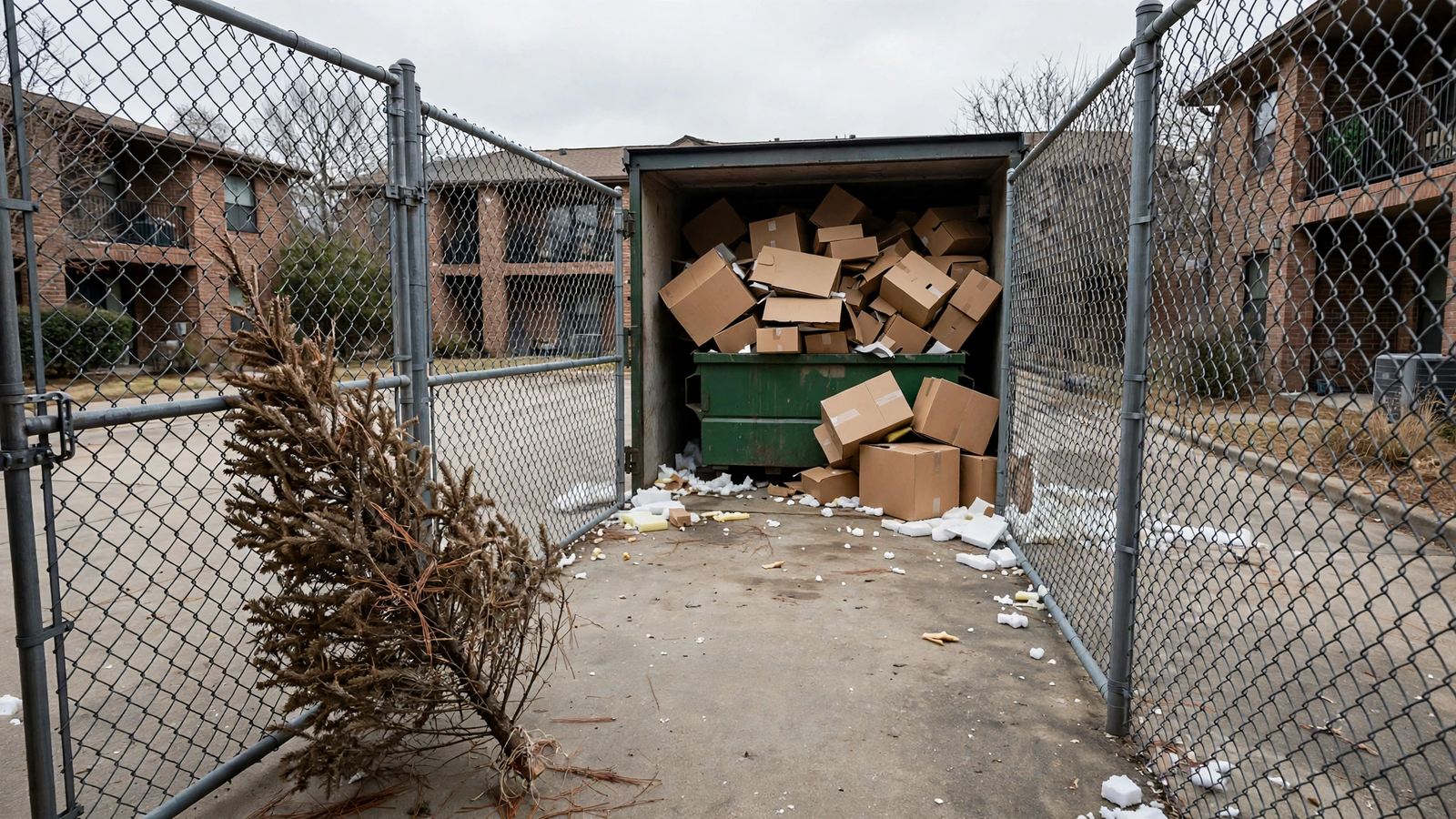
Seasonal bulk items are the dangerous category. Christmas trees, broken ornaments, holiday décor, packaging foam from large gift items, and the shipping boxes that didn’t fit the recycling bin all appear in dumpsters within a 7-day window in early January. This is the surge that causes overflow photos. It arrives after most property teams have mentally moved past the holidays, which is why it’s the most common cause of January complaints.

Why does the valet trash service get blamed for the dumpster problem?

Residents don’t distinguish between your valet trash contract and your dumpster hauler contract. They see trash sitting around, and the vendor whose logo is most visible — the valet trash crew they see nightly — becomes the vendor they complain about.

In practice, your valet trash service handles bagged household waste from unit doors. It doesn’t handle bulk items, Christmas trees, large boxes, or anything that doesn’t fit the bagged-waste scope. Those go to your dumpster and are the responsibility of your hauler contract.

This matters during holiday planning for two reasons. First, increasing valet trash service doesn’t solve the real holiday overflow problem, which is dumpster capacity. Second, if your valet trash contract starts getting blamed for January overflow, the issue to raise with the vendor is scope clarity in resident communication — not service failure.

For a full breakdown of what sits inside and outside the valet trash scope, see our piece on where the service scope line sits.

The 6-week planning timeline

Published early October to give you time to run it. The hauler-coordination deadlines are the ones that can’t slip — if you miss them, you’re paying emergency-service rates in December.

Planning timeline running from early October to early January. Hauler deadlines are the hard dates; everything else has some flex.
Week Primary task Deadline-sensitive?
Week of Oct 13 Pull last year’s dumpster overflow log, hauler emergency-pickup invoices, and resident complaint records from Nov 15 – Jan 10. Identify peak days and peak categories. No — but if you don’t do it now, step 2 is a guess.
Week of Oct 20 Project this year’s volume. Conservative baseline is 25–40% above normal for peak weeks, concentrated in cardboard and bulk. Occupancy change versus last year adjusts the number proportionally. No.
Week of Oct 27 Contact your dumpster hauler. Request increased frequency for Thanksgiving week, the week of Dec 22, and the week of Jan 5. Get the frequency change in writing, with the cost delta stated. Yes. After Nov 7, most haulers can’t adjust routes.
Week of Nov 3 Confirm hauler holiday schedule and any route adjustments. Order a temporary roll-off if last year’s data shows you’ll need overflow capacity in early January. Yes. Roll-offs for early January book 6–8 weeks ahead.
Week of Nov 10 Resident communication #1: pre-Thanksgiving. Cardboard flattening, where to put bulk items, what the valet trash service does and doesn’t take. Soft deadline. Post-Nov 20 is too late to shape Black Friday delivery behavior.
Week of Nov 24 Daily walk of dumpster area starting Monday. Note what’s going wrong — the Monday after Thanksgiving is a preview of Dec 26 and Jan 2. No.
Week of Dec 1 Resident communication #2: pre-Christmas. Repeat the cardboard and bulk guidance. Add Christmas tree disposal instructions if your property allows them. Soft deadline.
Week of Dec 15 Confirm hauler is still on the increased schedule you booked in October. Confirm your temporary roll-off delivery date for January. Operational. Catches hauler scheduling errors before they become January overflow.
Week of Dec 29 Resident communication #3: post-Christmas. Tree disposal, box flattening, where bulk items go, when the roll-off arrives if you ordered one. Hard deadline. Send Monday Dec 29 at latest.
Week of Jan 5 Daily walks of dumpster and recycling area. This is the peak week. Document everything you’d want to improve for next year. No.
Week of Jan 12 Review. Hauler invoice total, emergency pickup count, complaint count, overflow photo count. File it with the Oct 13 data for next year. No.

What resident communication actually works?

Three messages across the six weeks: pre-Thanksgiving, pre-Christmas, post-Christmas. Short, specific, and tied to a visible place where the resident makes the disposal decision. Property-wide emails get skimmed; a flyer at the dumpster area and a lock-screen notification on pickup nights get read.

Content that matters:

  • Flatten cardboard before placing it in the recycling area. An unflattened box fills five times the space of a flattened one. This is the single highest-leverage behavior change.
  • Where bulk items go. Named location, named day. If bulk items go to the dumpster, say so. If they require a scheduled pickup, say that with instructions.
  • What the valet trash service does not take. Christmas trees, large boxes, broken furniture, packaging foam. Scope clarity here prevents complaints that your valet service failed when it was never asked to handle those items.
  • Christmas tree disposal. If your city or hauler offers tree collection, give the date and location. If not, say what residents should do instead.
  • When the dumpster area will be at capacity. Honest expectations outperform cheerful ones. If Dec 26 and Jan 2 are the two days the area will overflow, say so, and name when extra service is scheduled.

This runs on the same compliance principles as everyday valet trash rules. More on that in our piece on why residents ignore valet trash rules and what actually fixes it.

What your maintenance team should be doing differently

Four changes to the normal routine, running from Nov 15 through Jan 10.

Daily dumpster area walk-through. Not a weekly inspection. Daily. Photograph anything unusual. The photo log becomes your evidence file if you need to escalate to the hauler for missed pickups or request emergency service.

Faster response to overflow. A bag outside the dumpster for one day becomes a pile for two days. The threshold during holiday weeks is “clear within 2 hours,” not “clear within 24.” If your maintenance team is already stretched, this is where you temporarily reassign porter hours from lower-priority tasks.

Separate pile for bulk. If your property doesn’t have dedicated bulk collection, designate a specific spot — ideally fenced or screened — for bulk items between Dec 26 and Jan 5. Trees, boxes, packaging foam go there and get hauled in one batch rather than filling the regular dumpster.

A written log of extra hauler service. Every emergency pickup, every schedule change, every charge. This becomes your negotiating leverage at renewal and your reference data for next year’s planning.

What this costs, roughly

Three cost increases to budget for, in order of magnitude.

The largest is incremental hauler frequency. Depending on your contract, one extra pickup per week during peak weeks typically runs 25–60% of a normal weekly rate per extra pickup. Over the 6-week peak period, that’s a real line item, and it’s most of what you’re spending on holiday waste management.

Second is any temporary roll-off container, which runs a fixed delivery, rental, and haul fee — often $400–800 for a 1–2 week placement, depending on size and market.

Third is incremental maintenance labor, which is usually absorbed into existing porter hours unless the property is already understaffed. If you’re redirecting porter time to dumpster monitoring, something else gets deprioritized. Decide in advance what that is.

Your valet trash contract rate shouldn’t change for the holidays. For context on how the per-door rate and billing basis are structured, see our valet trash pricing guide., because the scope doesn’t change. If your valet vendor proposes a holiday surcharge for handling bulk items, that’s a scope expansion request — treat it as a separate quote, not as part of the recurring contract.

What goes in next year’s playbook

The January 12 review week is where you make this easier for next year. Three questions to answer in writing:

What did we spend on hauler service above baseline? This becomes next year’s budget line and tells you whether to negotiate an annual holiday-adjusted contract instead of ad-hoc requests.

What were the three worst days? Overflow photos, complaint volume, and visible failures. Next year’s plan concentrates resources on those three days specifically.

What communication worked? Which notice reduced which problem. If the pre-Christmas cardboard reminder dropped unflattened boxes measurably, that message gets sent earlier next year.

A holiday waste plan is iterative. The first year documents the baseline. The second year addresses what the first year surfaced. By year three, the January 2 dumpster area looks the same as the June 2 one, and that’s the real success criterion.

Planning your property’s holiday waste coverage?

Verdant provides valet trash, trash-out, and bulk-removal services across the Dallas–Fort Worth metroplex. If your current valet service is being asked to handle work outside its scope, or you need bulk removal to supplement your hauler during peak holiday weeks, we can quote the add-on without disrupting your existing contracts.

Request a quote or call 888-520-0340.
Valet Trash Service

Five Reasons Property Managers Cancel Valet Trash Contracts (and How to Avoid Repeating Them)

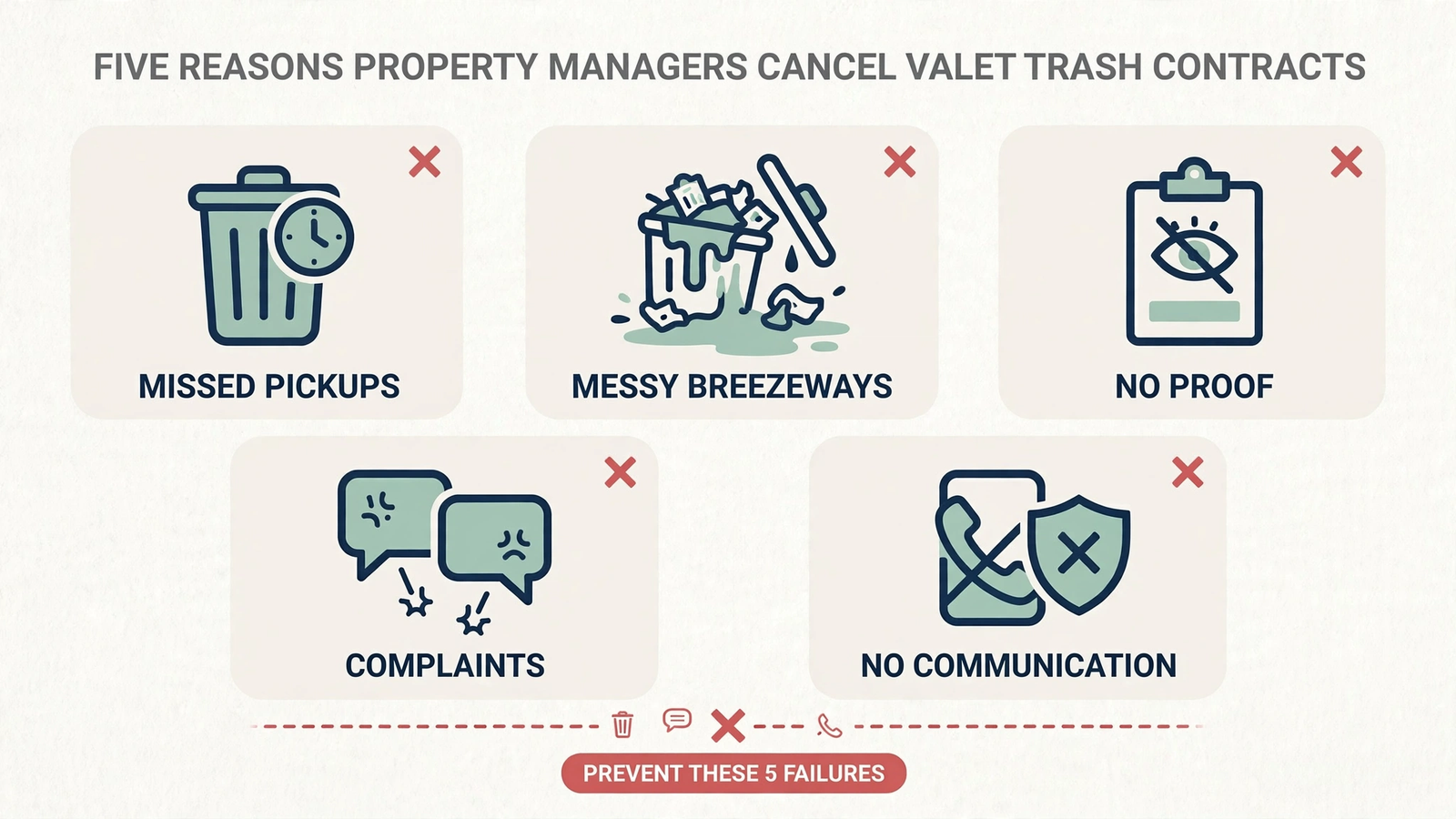
Property managers cancel valet trash contracts for five reasons, and none of them is the one they name on the way out. The stated reason is usually a single missed night or an angry resident email. The real reason is a pattern the vendor didn’t fix, a term the property never should have signed, or a cost that quietly stopped paying for itself. This piece walks through what actually fails, how to check for it before your next contract, and when cancellation is the right decision versus when it just moves the same problem to a new vendor.

Written for the property manager side of the table. If you’re weighing whether to renew, cancel, or rebid a valet trash contract, this is the diagnostic.

How do valet trash contracts actually fail?

They rarely fail in one moment. A contract that gets cancelled has usually accumulated three or four unresolved patterns over six to nine months, until a single event — a corporate reviewer walking the property, an owner complaint, a resident review that goes viral inside the leasing office — makes the pattern visible enough to act on.

The event isn’t the cause. The pattern is. Which is why replacing a vendor without understanding the pattern often puts the property in the same position six months later, with a new logo on the invoices.

The five patterns below account for almost every cancellation we’ve seen or heard about across DFW multifamily.

Reason 1: Missed pickups that stopped being outliers

Every valet trash vendor misses a night occasionally — a truck breaks down, an attendant calls out, a route runs long. That’s tolerable. The pattern that isn’t tolerable is when misses become weekly, cluster on the same nights, or hit the same buildings within your property.

What you’re actually observing when this happens is a route problem the vendor hasn’t solved: understaffing, driver turnover, or a route that grew past what one attendant can cover in the pickup window. The vendor knows. They usually hope the property doesn’t notice.

What to check before signing the next contract: ask for written missed-service credits. Not a phone commitment. A clause in the contract that says: for every missed night, the property receives a credit at a defined rate per door, applied to the next invoice, without the property having to submit a claim. If the vendor won’t put that in writing, they know their reliability is a risk.

What to check while your current contract is still running: log every missed night for 60 days. If misses correlate to specific nights, buildings, or attendants, the vendor has a structural problem, not a bad-luck problem.

Reason 2: Issues get acknowledged, not resolved

You email the account manager. They apologize, promise it won’t happen again, and ask you to give the team a chance. It happens again the next week. You email again. Same response. This is the second-most-common failure mode, and it’s the one property managers underestimate because each individual exchange feels polite and productive.

The test isn’t whether the vendor responds. It’s whether the response is followed by measurable change. A corrective plan with a date, an owner, and a checkpoint is a resolution. “We’ll talk to the team” is an acknowledgment. Confusing the two is how contracts die slowly.

What to check before signing: written response-time commitments and an escalation path. Under 4 hours for acknowledgment, 24 hours for resolution or a written plan, and a named escalation contact above the account manager. Absence of any of these means you have no recourse when issues stall.

What to check while running: pull the last three months of your email thread with the account manager. Count how many issues have a specific resolution date attached versus how many end with “we’ll get on it.” If the ratio tilts toward the second, the contract is drifting toward cancellation.

Reason 3: Complaints piling up faster than the vendor addresses them

Individual resident complaints about valet trash are inevitable. The question is what’s underneath them, and whether the vendor is treating each complaint as an isolated apology or as data.

Complaints that cluster around specific rules — the pickup window, prohibited items, bag placement — usually trace to a communication or rules problem, not a vendor problem. Complaints that cluster around specific nights or buildings usually trace to route or staffing problems. Complaints that cluster around resident conduct — bags left out too early, non-compliant items in the stream — trace to a compliance system the property hasn’t built.

The vendor should be able to tell you which cluster your complaints fall into. If they can’t, they’re not tracking them, and they’re addressing symptoms one by one until you get tired of forwarding them.

What to check: ask the vendor for a monthly summary of complaints broken down by root cause. If they don’t produce one, you’re the one doing the tracking, and you’re the one making the case for cancellation without vendor data. That’s a fixable ask: any reasonable vendor can start tracking this if you require it.

Reason 4: The property doesn’t look the way the contract promised

Bags visible outside doors during daylight hours. Corridor floors stained from leaking bags. Overflowing dumpster surrounds on Monday mornings. Prohibited items sitting where the valet crew left them because they can’t be lifted safely.

These are the visible failures. They matter because they’re what your regional manager, your owner, and every prospective resident sees when they walk the property. A contract can be technically performing — every scheduled pickup completed on time — and still be failing because the definition of “pickup completed” was too narrow to protect appearance.

What to check before signing: whether the base scope includes handling of non-compliant items (typically it doesn’t, and needs a written add-on process), whether the vendor’s crew sweeps the pickup area or only the bags, and what “completed pickup” means for a bag that leaks or an item that’s prohibited. Get the definitions in writing.

What to check while running: walk the property at 7:00 a.m. on a pickup morning, before the office opens. Not the front entrance — the interior corridors, the trash rooms, the dumpster surrounds. If what you see doesn’t match what the contract promised, you have your evidence.

Reason 5: The math stopped working

The one nobody talks about. A contract can be running smoothly and still get cancelled because the numbers changed. Occupancy dropped, the resident fee stayed the same, the vendor rate escalated at renewal, and the net revenue from the program quietly went to zero or negative.

This is a specific failure mode of contracts written on a total-units basis rather than an occupied-units basis. We covered the math in detail in our valet trash pricing guide — the short version is that below roughly 85% occupancy, a lower total-units rate can cost more than a higher occupied-units rate, and property managers usually don’t run this check until the annual budget review surfaces the gap.

What to check before signing: whether billing is on total units or occupied units, and what the escalator is at renewal. A 3% annual escalator on a total-units contract while your occupancy trends down is a compounding problem.

What to check while running: pull your current per-door cost, your current resident amenity fee, and your current occupancy. If (occupancy × fee) is trending toward (total units × rate), the program isn’t paying for itself and cancellation may be the right answer — but not for the reasons anyone will state.

When is cancellation actually the right call?

Three conditions.

The same failure repeats after written escalation. Not verbal escalation, not an email chain — a written, dated escalation letter that names the specific pattern, references the contract clauses being breached, and requires a corrective plan. If the vendor either won’t produce a plan or produces one and misses its own checkpoints, cancellation is defensible and often the only option.

The vendor can’t demonstrate improvement with data. A vendor asking for another chance without complaint trend data, missed-pickup logs, or a specific corrective plan is asking you to trust that things will change on faith. Six months of the same faith request is the pattern that produces cancellation.

The math no longer works. If the fully loaded cost of the program exceeds the resident amenity fee at your current occupancy, the program isn’t paying for itself and it isn’t going to. Renegotiating to an occupied-units basis is worth trying first. Cancellation is the fallback.

When cancellation is the wrong call

Three conditions on the other side.

The problems trace to your compliance system, not the vendor’s execution. If most complaints are about residents leaving bags out early or putting prohibited items in the stream, that’s a rules and enforcement problem the property owns. Changing vendors doesn’t fix it. We covered this in our piece on why residents ignore valet trash rules.

The contract terms are the failure. If your total-units contract is bleeding money at 74% occupancy and the vendor is meeting every operational commitment, cancelling and rebidding gets you the same math from a new vendor. Renegotiate the terms instead.

You haven’t given a written escalation. A cancellation that follows only verbal complaints often surprises the vendor, and it usually costs the property leverage on any refund of prepaid fees, transition period, or missed-service credits already owed. Written escalation first, cancellation second.

What to do before you sign the next one

The failure modes above are almost all avoidable at signing, if the contract is written to catch them. A short list to negotiate before you sign, in priority order:

  1. Billing basis. Total units or occupied units, with the definition in writing. This moves your effective cost more than the headline rate.
  2. Missed-service credits. Automatic, per-door, applied to the next invoice, with no claim required.
  3. Response-time and resolution commitments. Under 4 hours for acknowledgment, under 24 hours for a written corrective plan when the issue is systemic.
  4. Escalation path. A named contact above the account manager, in the contract.
  5. Scope of “completed pickup.” Including how non-compliant items are handled and whether the crew sweeps the pickup area.
  6. Rate escalators at renewal. Capped, and tied to a specific index rather than “market rate.”
  7. Termination clauses. A cure period that lets you exit if written escalations aren’t resolved, without penalty.
  8. Three DFW references from properties the vendor has served for at least a year. Call them.

Most cancelled contracts failed on terms that were negotiable at signing. The next contract doesn’t have to fail the same way.

Reviewing your valet trash contract?

Verdant provides valet trash service across the Dallas–Fort Worth metroplex. Send us your current terms and we’ll walk through them with you — no obligation, no pressure to switch. If the math or the terms don’t work, sometimes the best answer is a renegotiation with your existing vendor, and we’ll say so.

Request a quote or call 888-520-0340.

Valet Trash Service

Why Residents Ignore Valet Trash Rules, and What Actually Fixes It

Most valet trash violations aren’t a resident problem. They’re a system problem. Bags placed at the wrong time, prohibited items in the stream, corridors staying messy — these are almost always symptoms of rules that were unclear, inconvenient, unexplained, or unenforced. Fixing the system resolves more violations than penalties do, and it’s the single biggest lever a property has for keeping a valet contract from getting quietly cancelled at renewal.

This piece explains the real drivers of non-compliance, why more emails don’t work, and the enforcement ladder that turns chronic complaints into a settled operational routine.

Why does this matter beyond the corridor?

Non-compliance shows up as more than a housekeeping annoyance. Bagged trash sitting out for hours attracts pests and, in the summer, produces the odor complaints that end up in Google reviews. Prohibited items in the stream create disposal-fee surprises that hit the property’s bill, not the vendor’s. Overflowing valet setups violate fire code in interior corridors.

And it costs contracts. Chronic non-compliance is one of the top reasons a property drops valet trash service altogether. The complaint the regional manager hears isn’t “residents are ignoring the rules.” It’s “this service isn’t working.” The rules aren’t the service, but that distinction rarely survives a bad quarter of reviews.

Framed that way, resident compliance is not an on-site cleanliness problem. It’s a contract-preservation problem, and it belongs on the regional manager’s radar.

Why don’t residents follow the rules?

Because the rules assume behavior the environment doesn’t support. Six patterns cover almost every case.

The instructions were never really given. Move-in packets contain fifty pages. Trash policy is on page 34. The resident scanned the first three pages and signed. The rules technically exist. Nobody read them.

The window doesn’t fit real life. Pickup runs 6:00 to 8:00 p.m. The resident works a late shift and gets home at 9:30. Placing the bag “before pickup” means placing it before leaving for work, which the rules also prohibit. Both statements are true and mutually exclusive.

Social proof runs the other way. A resident sees three neighbors leave bags out at 4:00 p.m. Nobody’s been cited. They conclude the rule isn’t real, or isn’t enforced, or is unenforceable. That conclusion is often correct.

The “why” was never stated. A resident asked not to put liquid in bags doesn’t understand it’s because the bag will burst when the attendant lifts it. Without the reason, the rule reads as arbitrary and gets ignored on the specific occasion it feels inconvenient.

Prohibited items were never listed clearly. Cardboard, liquids, hangers, glass, hazardous items, bulk pieces — the resident doesn’t have that list. They put the pizza box out. It doesn’t get taken. They’re annoyed at the service.

Enforcement has been inconsistent. The resident got a warning six months ago and nothing since, despite repeating the same behavior. They’ve learned the warning was a bluff.

None of these describe a bad person. They describe an environment that made the rule easier to break than to follow. The fix is to change the environment.

Why don’t more reminders work?

Because reminders address a memory problem the property doesn’t have. Residents remember. They chose not to follow the rule, and no version of “Please follow valet trash guidelines” changes the reason they made that choice.

Here’s the contrast:

The same rule, communicated two ways. The second doesn’t just repeat the rule — it removes the reasons people break it.
Generic reminder Effective instruction
“Please follow our valet trash guidelines. Bags should be placed out before pickup.” “Pickup is Sunday–Thursday, between 7 and 9 p.m. Bags placed before 6 p.m. attract pests and are the #1 reason residents get fined. If you work late, keep bags inside until you get home — even after 9 p.m. is fine, we’ll get it the next night.”

The second version tells the resident the specific window, the reason the early-placement rule exists, and the alternative for people whose schedule doesn’t fit. It removes three of the six patterns above in seventy words.

Reminders scale. Instructions solve.

What actually improves compliance?

Five system changes, ranked by impact. If you only do one, do the first.

1. A written escalation ladder

The single largest change is making consequences predictable. Residents follow rules that carry consistent, known consequences. They ignore rules that carry inconsistent or invisible ones.

A sample four-step ladder. Fee amounts are illustrative — set yours in line with lease language and any local rules governing amenity fee changes.
Step Trigger Action Documentation
1 First observed violation Written notice with a photo, no fee Attach photo to resident file
2 Second violation, any type Courtesy fee with lease clause cited Photo + citation, chargeback to ledger
3 Third violation Fee doubles; formal note in file Photo, prior notices attached
4 Repeat pattern Lease-level action per the property’s non-compliance policy (see also: move-out trash-out checklist) Full compliance history

Two conditions make this ladder work. It has to be applied consistently across residents — the resident in unit 214 gets the same treatment as the resident in unit 508. And each step has to be tied to specific lease language the resident agreed to at move-in. A ladder invented at the office desk after a bad week won’t hold up.

2. Put the rules where the decision happens

Rules in a move-in packet are not where residents make disposal decisions. Rules on the back of the trash bin caddy, on a laminated card inside the caddy lid, or in the lock-screen notification a resident portal app sends on pickup nights are.

Move the information to the point of decision. That single change reduces friction-driven violations more than any resident newsletter will.

3. Explain the reason, once, briefly

Every rule that survives contact with a resident carries a one-line reason. “No liquids — bags burst when lifted.” “No cardboard — separate recycling stream.” “Bags after 6 p.m. — earlier attracts pests.” When a resident understands why a rule exists, compliance stops being about obedience and starts being about not causing a specific problem they now see.

4. Track violations the way you track work orders

Which rule gets broken most? In which building? On which pickup night? By new residents in their first ninety days, or by long-term residents who have quietly stopped following the rules? Without that data, every intervention is a guess.

A property that tracks compliance patterns can address the actual driver — a new-resident orientation gap, one specific building where the caddies are broken, a pickup window that was fine in winter and stopped fitting when summer schedules shifted. Every one of those is a specific fix. None of them are solved by another mass email.

5. Fix the operational friction

Sometimes the rule itself is the problem. If a large share of residents get home after the pickup window and the property expects strict compliance with a 7:00 p.m. deadline, the property has created its own violation rate. Options include shifting the window later, running two pickup shifts, or explicitly allowing bags out after the window with an understanding they’ll be collected the next night.

Ask the vendor which of these fits their route economics. A minor window change from Verdant’s side can eliminate a violation category entirely.

A 30-day compliance reset

If your community is running a chronic violation rate right now, run this in the next month:

  1. Week 1. Pull the last 60 days of complaints and observed violations. Group them by rule type, building, and time. Look for the pattern that accounts for most of the volume.
  2. Week 2. Rewrite the top violated rules using the “instruction, not reminder” format above. Post them at the point of decision, not just in the portal.
  3. Week 3. Publish the escalation ladder to residents in writing. Not as a threat — as a clarification. Everyone should know exactly what happens at step one and step three.
  4. Week 4. Enforce the ladder consistently for that first week. This is the week the ladder becomes real, and residents update their mental model of what the community actually enforces.

The measurable outcome you’re looking for isn’t zero violations. It’s a repeatable process — a system where the same rule violated twice by the same resident produces the same response, and the property’s regional manager stops hearing complaints scale with the calendar.

Fix the system, not the violation

The compliance problem is rarely the resident. It’s an environment where rules were vague, inconvenient, unexplained, or unenforced — and a resident population that reasonably concluded the rules didn’t really mean what they said.

Communities that fix the system see two changes at once: violations drop, and the pressure to cancel the valet contract at renewal disappears. Both matter, and both come from the same work.

For context on the contract side of the program, see how valet trash is priced in DFW — the billing basis and contract term decisions interact with how much leverage you have on operational changes like window shifts.

Rethinking your valet trash program?

Verdant provides valet trash service across the Dallas–Fort Worth metroplex, including operational support for property teams working through compliance changes. We’ll walk your property, review your current rules, and quote against your actual routine.

Request a quote or call 888-520-0340.

Make Ready

What’s Included in a Make-Ready, and What Gets Billed Separately?

A standard make-ready covers routine turnover cleaning, cosmetic touch-up, hardware and fixture checks, and a punch-list walk on an empty unit in expected wear condition. Anything that requires materially more labor than a standard turn — deep cleaning, restoration, repairs above a threshold, appliance replacement, junk removal — sits outside the base and gets billed as a separate line item. The distinction is not what the vendor can do. It’s what a single per-unit price is calibrated to.

The scope line between “make-ready” and “everything else” is where most billing disputes happen. This piece defines the baseline, lists the conditions that push a unit into add-on territory, and gives you a scope structure that prevents on-site change orders.

If you’re deciding whether a unit needs a make-ready at all, or whether it needs a trash-out first, start with the scope-line piece. This one assumes you’ve already decided a make-ready is what you’re buying.

What is a standard make-ready?

A make-ready is the work required to turn an empty unit into a leasable one. Standard scope, at Verdant, covers the same eleven items on every turn:

  • Routine turnover cleaning across the unit
  • Paint touch-up on nail holes and light scuffs
  • Caulking at tubs, sinks, and countertops
  • Hardware tightening and replacement of missing pieces
  • Fixture testing — every switch, outlet, light
  • Appliance testing — burners, oven cycle, dishwasher, disposal, fridge, microwave
  • HVAC filter change
  • Smoke and CO detector check and battery replacement
  • Minor drywall repair — small holes, seam pops
  • Door and lock function check, blind function check
  • Punch-list walk-through against the property’s leasing standard

The scope assumes two things: the unit is empty of the outgoing resident’s belongings, and the interior condition reflects normal wear from a single lease term. When either assumption fails, the pricing changes.

What does routine turnover cleaning cover?

Turnover cleaning inside a standard make-ready covers surface-level work in every room. Enough to get the unit rent-ready, not enough to restore neglect.

Kitchen

Counters, cabinet exteriors and interiors, sink and faucet, backsplash, floor. Appliance exteriors and interiors at surface condition — oven wiped, fridge shelves cleaned, microwave interior cleaned. Not: baked-on oven residue, heavy grease behind the range, months of buildup inside a fridge left running with food.

Bathrooms

Toilets, sinks, vanities, mirrors, tub and shower, fixtures, tile, floor. Normal soap and water residue clears in standard scope. Heavy soap scum, hard-water staining that requires acid treatment, or mildew requiring remediation does not.

Bedrooms and living areas

Dusting, vacuuming, mopping, baseboards, door faces and frames, light switches, closet floors. Marks that need spot cleaning rather than repainting. Pet hair at normal shed levels.

Touchpoints

Door handles, switch plates, thermostat, cabinet pulls, railings. Included in every turn.

The through-line: routine turnover cleaning addresses the residue of one lease term. It doesn’t reverse years of buildup and doesn’t restore a unit from a distressed state.

What gets billed as a separate line item?

Anything that pushes labor materially above the standard per-unit assumption. The table below groups the common ones by category.

Make-ready billing boundary. “Extra” means the item is quoted as a separate line, not that the vendor won’t do it. Ranges depend on unit size and condition; get a written quote before authorizing.
Category In standard make-ready Billed separately
Cleaning Routine turnover cleaning across all rooms Deep cleaning; oven restoration; heavy soap-scum removal; hard-water treatment; nicotine residue; pet odor treatment
Paint Touch-up on nail holes and light scuffs Full-wall paint; full-unit repaint; accent-wall coverage; heavy adhesive or crayon removal
Flooring Vacuum, mop, spot clean Carpet extraction; carpet replacement; hard-flooring refinishing; tile grout restoration
Appliances Test, wipe, verify function Appliance replacement; OTR microwave install; disposal replacement; heavy interior restoration
Plumbing fixtures Test, tighten, verify seal Faucet replacement; toilet replacement; angle stop replacement; water heater work
Drywall and structure Minor patching — small holes, seam pops Large hole repair; wall replacement; texture matching over broad areas
Removal Nothing — unit is assumed empty Furniture, mattresses, appliances left behind, bagged trash, exterior debris. See trash-out service
Specialty Not covered Biohazard cleanup; mold remediation; pest-related decontamination; smoke damage restoration
Exterior Not covered Pressure washing; patio or balcony debris removal; siding cleaning

How do you tell “dirty” from “excessive”?

Language does most of the damage here. “Deep clean,” “heavy clean,” “make it right” — none of those terms specify what a crew does or what it costs. Two examples of the same category on different sides of the line:

Oven, standard. Cooked food residue, some splatter, a fried-food coating on the interior. Cleans in the time a standard make-ready allocates.

Oven, extra. Months of baked-on grease that requires overnight chemical treatment, or a self-clean cycle plus manual scraping. Same appliance, two to four times the labor.

Bathroom tile, standard. Soap film, water spots, light mildew on grout at fixture edges.

Bathroom tile, extra. Chronic hard-water calcification requiring acid, or grout staining that requires resealing to restore.

Carpet, standard. Vacuumed, spot-treated at obvious stains, ready for the next lease.

Carpet, extra. Pet urine at pad level, cigarette burns, or staining that reaches the pad. Full extraction or replacement.

The test isn’t visual. It’s labor. If the condition takes materially longer than a standard turnover cleaning assumes, it’s an add-on regardless of what the surface looks like.

Who pays for the extra work?

Two separate questions, and they get answered on different tracks.

Track one: vendor to property. Verdant bills the property for the actual work performed. Standard make-ready at the contracted per-unit rate, plus any add-on line items quoted and approved. That invoice reflects labor delivered, not who caused the condition.

Track two: property to resident. The property separately decides whether any portion of the additional cost is charged back to the outgoing resident from their security deposit. That decision depends on the lease, the move-in condition documentation, the state and local rules governing deposit disposition, and the property’s own policy.

Those tracks operate independently. A vendor’s invoice for oven restoration is a labor charge. Whether it can be recovered from the resident is a legal and contractual question the property answers on its own timeline. Don’t hold up the vendor invoice waiting for that decision — and don’t automatically pass the vendor’s number through as a resident charge without checking the lease and applicable rules.

How do you prevent scope surprises before the crew arrives?

Publish the boundary in writing, before the work order goes out. The structure that works:

  1. A named baseline scope per unit type — studio, one-bedroom, two-bedroom, three-bedroom. Same eleven items, priced per size.
  2. A published add-on menu with unit prices for the common items: oven restoration, carpet extraction per room, full-unit paint, appliance swap, angle stop replacement.
  3. A pre-work condition photo requirement. The crew photographs any condition that appears to push the unit into add-on territory before starting the additional work.
  4. An approval threshold. Under a dollar amount, the crew proceeds and reports. Over it, the crew stops and gets sign-off. Both sides know the rule going in.
  5. A completion standard. A written definition of what “ready” means for your leasing office, so the punch-list walk isn’t subjective.

Standardized across a portfolio, this structure produces predictable per-unit costs and comparable numbers across properties. Without it, you’re comparing apples to oranges every quarter.

A short make-ready scope checklist

Use this before dispatching a vendor to a unit:

  • Is the unit empty? If not, trash-out first, then quote the make-ready.
  • Is the interior in expected single-lease-term wear condition?
  • Are there any of the add-on triggers — oven, tile, carpet, paint, appliances — visible in the walk-through photos?
  • Have you shared photos of any exception condition with the vendor before they arrive?
  • Does the work order specify baseline scope, approved add-ons, and the approval threshold for anything discovered on-site?
  • Does the work order name the completion standard the punch-list walk is graded against?

Six questions. Two minutes per unit. Prevents most of the invoices you’d otherwise argue about.

Frequently asked questions

Is a make-ready the same as a deep clean?

No. A make-ready is a turnover scope that includes routine cleaning plus cosmetic and functional checks. Deep cleaning is a specific, more labor-intensive cleaning scope that addresses accumulated buildup and is quoted separately.

Should appliance cleaning be in the base make-ready?

Surface cleaning and function testing, yes. Restoration-level cleaning of neglected appliances, no.

Are minor repairs included?

Minor drywall patches, hardware replacement, caulking, and fixture testing are included. Repairs above a defined dollar threshold, or work that requires a specialty trade, are separate line items.

Does the vendor decide what counts as “extra”?

The scope should decide, not the vendor. That’s the point of publishing the baseline and add-on menu in advance. A vendor who quotes an add-on should be pointing at a specific item on that menu.

If your property also runs a doorstep collection program, see how valet trash is priced in DFW — the per-door rate and billing basis sit in the same budget line as your make-ready costs.

Get a scoped make-ready quote

Send us the unit type and condition photos. We’ll return a baseline per-unit rate with any add-on line items priced from the same menu we use across every property we service.

Request a quote or call 888-520-0340.

Make Ready Trash Outs

Trash-Out or Make-Ready? Where the Scope Line Sits

A trash-out removes what should not remain in the unit. A make-ready fixes what stops the unit from leasing. The confusion between the two is the most common source of billing surprises in unit turnover, because a work order labeled “make-ready” that arrives at a unit full of a former resident’s furniture is not a make-ready — it’s two jobs, and it will be quoted as two jobs.

This piece defines the boundary, gives you a scope table you can hand to a vendor, and explains how to write a turnover work order that survives contact with the property.

What does a trash-out include?

A trash-out is the removal of abandoned or unwanted contents from a unit. Furniture, mattresses, bagged garbage, loose debris, appliances the resident left behind, and anything else that shouldn’t be there when the next resident walks in.

Trash-out work is most often triggered by move-outs that end badly — skips, evictions, foreclosures, abandoned units, occasionally the estate of a deceased resident. The scope is measured by volume and access. A studio with three bags and a lamp is a different job than a two-bedroom stacked to the ceiling.

What a trash-out does not include: cleaning, painting, repairs, fixture replacement, carpet, or anything that touches the unit’s finish. It empties the unit. It doesn’t ready it.

A useful test: if the primary objective is to make the unit empty, it’s a trash-out. If the primary objective is to make it rentable, it isn’t.

What does a make-ready include?

A make-ready is the work required to return an empty unit to a leasable condition. The scope varies by property, contract, and the state the resident left the unit in, but a standard make-ready includes the tasks below.

Verdant’s standard make-ready covers eleven items on every unit: caulking, paint touch-up, hardware tightening and replacement, fixture testing, appliance testing, HVAC filter change, smoke and CO detector check, minor drywall repair, door and lock function, blind repair, and a punch-list walkthrough. That’s the baseline.

Beyond the baseline sit the add-ons: full-unit paint, appliance replacement, water heater work, angle stops, OTR microwave installation, and other items scoped per unit condition. These are quoted separately because unit condition drives the count, and the count drives the cost.

The make-ready assumes the unit is empty. That’s the load-bearing assumption in every make-ready quote, and it’s the assumption that gets a change order raised when it turns out to be wrong.

Where does the scope line actually sit?

The line is not about where the vendor’s truck stops. It’s about what condition the unit is in when the vendor arrives, and what condition it needs to be in when the vendor leaves.

Turnover scope boundary. Every task on the make-ready side assumes the trash-out side is already complete.
Trash-out Make-ready
Objective Empty the unit Ready the unit for the next lease
Starting condition Occupied by contents that shouldn’t be there Empty of contents
Finishing condition Empty, floors clear, debris hauled Clean, functional, cosmetically acceptable, walkthrough-ready
Typical labor Removal crew, hauling, disposal Painters, cleaners, minor repair techs, punch-list walk
Materials handled Furniture, appliances, bagged trash, loose debris Paint, caulk, filters, hardware, replacement fixtures
What’s included in the base scope Load, haul, disposal, basic site cleanup Verdant’s 11-point baseline (see above)
What’s typically extra Hazardous materials, biohazard cleanup, exterior debris Full-unit paint, carpet, appliance replacement, water heater, angle stops
What drives price Volume of material, access, disposal fees Number of add-on items on the punch list
Estimating basis Per unit, adjusted for volume Per unit, adjusted for condition

Which service does your unit actually need?

Three scenarios cover most turns.

The clean move-out. Resident gave notice, moved out on schedule, unit is empty and in expected condition. This is a make-ready. Standard baseline, maybe a few add-ons depending on wear.

The abandoned or evicted unit with contents. Furniture, personal belongings, and trash left behind. Unit itself is in expected condition once emptied. This is a trash-out first, followed by a make-ready. Two scopes, two line items, usually two crews.

The distressed unit. Contents left behind, plus damage — holes in walls, damaged flooring, missing fixtures, appliance loss. This is a trash-out plus a make-ready with an expanded add-on list. The make-ready quote can’t be finalized until the trash-out is complete and the unit’s actual condition is visible.

That last point matters. If a vendor gives you a firm make-ready number for a unit still full of the previous resident’s belongings, the number is either padded or wrong. The condition assessment happens after the unit is empty.

Why does scope confusion cost so much money?

Because it stacks. A misread scope produces a change order. A change order produces a scheduling delay. A scheduling delay pushes the make-ready past the next resident’s move-in date, which triggers a leasing concession or a first-month rent credit. What started as a $400 miscategorization becomes $1,400 by the time the unit is leased.

The specific failure modes that show up on a portfolio:

  • The vendor arrives with a make-ready crew for a unit that needs a trash-out. Crew leaves, second crew mobilized, both charged.
  • The make-ready quote assumed empty. The unit wasn’t. Change order raised on-site.
  • Bids from different vendors are non-comparable because each defined “make-ready” differently.
  • Owner reports show inconsistent turnover costs across the portfolio because on-site managers used different work order categories for the same condition.

None of these are vendor problems. They’re scope problems.

How do you write a turnover scope that prevents this?

Write the work order around deliverables, not labels. A scope written to “make-ready this unit” invites interpretation. A scope written to specific starting and ending conditions doesn’t.

The structure that works:

  1. Starting condition, documented with photos of every room including closets and any exterior storage. Note anything unusual — appliances the resident took, damage, contents left behind.
  2. Removal scope. What needs to leave the property. If the answer is “nothing, the unit is empty,” say so explicitly.
  3. Cleaning scope. Which areas, to what standard. Reference your make-ready checklist.
  4. Repair scope. Named items with photos. Not “fix damage” — “patch three drywall holes in master bedroom, replace missing closet door in hall, replace bent blind in living room.”
  5. Cosmetic scope. Touch-up paint versus full-wall versus full-unit repaint. Named.
  6. Finishing condition. What “ready” means for your leasing standard. Include punch-list walk-through requirements.
  7. Exclusions. What’s outside this scope and requires a separate work order.
  8. Change order authority. Who approves additions, and up to what dollar amount without further sign-off.

This structure takes an extra ten minutes per unit and prevents most billing disputes.

What about scope creep during the job?

Scope creep is when the on-site manager, the vendor, or the punch-list walker adds tasks as they go — “while you’re in there, can you also…” The additions feel small in the moment and are almost never in the original quote.

Three rules keep it under control:

Photograph any condition that changes the scope before authorizing the work. If the vendor finds water damage behind the fridge that wasn’t in the original scope, that gets photographed and quoted before it’s fixed, not after.

Set an authorization threshold in the original work order. Under a certain dollar amount, the vendor proceeds and reports. Over it, the vendor stops and gets sign-off. Both parties know the rule going in.

Separate emergency work from turnover work. A busted water line found during make-ready isn’t a make-ready task, and shouldn’t be billed as one. It’s a separate scope, invoiced separately, so your turnover cost data stays clean.

What the scope line does for you

Portfolios that write turnover scopes to conditions rather than labels get three things: predictable per-unit costs, comparable vendor bids, and clean owner reporting. The vendor benefits too — no on-site arguments, no punch-list disputes, no scope drift.

The distinction is simple to state and easy to lose track of when a unit turns fast. Trash-out clears. Make-ready readies. Any work order that treats them as one job is a change order waiting to happen.

If your property also offers doorstep collection, see our breakdown of how valet trash is priced in DFW — the billing basis decision there interacts directly with your turnover budget.

Get a scoped quote for your next turn

Send us the unit condition — photos are enough — and we’ll return separate trash-out and make-ready line items with the baseline scope written out. No bundled numbers, no on-site surprises.

Request a quote or call 888-520-0340.

Valet Trash Service

How Is Valet Trash Priced? A DFW Property Manager’s Guide (2026)

Valet trash is priced per door per month, but five factors move that number more than the headline rate does: unit density and layout, pickup frequency, contract length, what is bundled into the base rate, and whether you are billed on total units or occupied units. That last one moves your effective cost more than the rate itself, and most bid comparisons ignore it entirely.

This guide explains how valet trash pricing is built in Dallas–Fort Worth, which variables actually shift a quote, and how to run the occupancy math on any rate you are given.

What is valet trash service?

Valet trash is doorstep waste collection for multifamily communities. A uniformed attendant collects bagged trash from outside each unit’s door on a set evening schedule — most commonly five nights a week, Sunday through Thursday, in a window between 6:00 and 8:00 p.m. — and carries it to the property’s compactor or dumpster.

It does not replace your hauler contract. Most communities run both a dumpster or compactor contract for bulk disposal and a valet trash program for doorstep convenience. Valet trash reduces strain on your containers and creates a billable amenity. It does not eliminate a waste line item.

How is valet trash priced?

Valet trash is priced on a per-door, per-month basis, quoted against your total unit count rather than per pickup or per bag. That single rate is what appears on a bid sheet, which is why bids look easy to compare and usually are not.

Two properties with the same unit count can receive materially different quotes because the underlying cost is labor and route time, not volume. What follows is what actually moves the number.

What determines your per-door rate?

Unit density and property layout

Layout affects a quote more than raw unit count does. A 300-unit garden community with exterior breezeway access lets one attendant cover far more doors per hour than a 300-unit property spread across six detached buildings with interior corridors, elevators, or gated sections. Ask any bidder how many doors per attendant-hour they are assuming for your property. If they cannot answer, they have not walked it.

Property size

Larger properties receive more efficient pricing because setup and drive time are fixed costs spread across more doors. Garden-style communities above 300 units are the most efficient profile in the industry. Smaller condo and townhome communities sit at the other end, where the same fixed route cost divides across fewer units.

Pickup frequency

Five nights, Sunday through Thursday, is the industry standard and the baseline most quotes assume. Adding weekend service, requesting non-standard collection windows, or running seven nights raises the rate because it changes staffing rather than just workload.

What is bundled into the base rate

Bins, doorstep signage, resident compliance materials, and recycling collection should sit inside the quoted rate. When they appear as separate line items, a low headline number stops being low. Compare the fully loaded monthly figure, not the per-door quote.

Contract length

Valet trash agreements commonly run a one-year minimum, with 24- and 36-month terms available. Longer terms usually carry a discount, but they also lock a rate before you know how the service performs at your property. A 36-month term on an unproven provider is a three-year problem.

What contract term decides whether the math works?

The clause that decides your margin is the billing basis: whether the provider charges you on total units or occupied units. Most valet trash contracts apply the monthly cost to the entire property regardless of occupancy.

That asymmetry matters because you pay on every door and bill only the leased ones. At full occupancy the gap is zero. At 88% occupancy on a 200-unit property, you are paying for 24 doors that generate no fee. Over a 36-month term, that gap compounds into a number worth negotiating over.

Ask every bidder one question before you compare rates: is this priced on total units or occupied units? A slightly higher occupied-unit rate can beat a lower total-unit rate outright at anything below roughly 85% occupancy. Most published pricing guides skip this entirely, and it is the most common reason a valet trash line item underperforms its pro forma.

What do residents pay for valet trash?

Residents in Dallas–Fort Worth are typically billed $25 to $35 per month as a mandatory amenity fee written into the lease. That band holds across national benchmarks and appears on lease documents throughout the metroplex, so it is the one number in this equation that is genuinely public.

The spread between what you pay a provider and what you bill residents is your net ancillary revenue. That spread, not the provider rate in isolation, is the figure that belongs in your budget.

At what occupancy does valet trash stop paying for itself?

On a total-unit contract, valet trash goes cash-negative when occupied units multiplied by the resident fee falls below total units multiplied by the per-door rate. The formula:

Break-even occupancy = (per-door rate ÷ resident fee) × 100

Substitute the rate you have been quoted and the fee you plan to charge. The table below runs the model at illustrative inputs so you can see the shape of the curve.

Illustrative model only. Inputs are a 200-unit property, a $12 per-door rate on a total-unit contract, and a $28 resident fee — chosen to demonstrate the formula, not to represent any provider’s pricing. Substitute your own quoted figures. Verdant analysis, August 2026.
Occupancy Occupied units Resident revenue Provider cost (200 doors) Net / month
95% 190 $5,320 $2,400 +$2,920
88% 176 $4,928 $2,400 +$2,528
75% 150 $4,200 $2,400 +$1,800
60% 120 $3,360 $2,400 +$960
43% 86 $2,408 $2,400 +$8

The practical read: for a stabilized DFW asset, valet trash is durably profitable at any realistic rate. The math only breaks on deep lease-up, heavy repositioning, or a property in distress. If you are taking over a 55%-occupied value-add deal, negotiate an occupied-unit basis or a lease-up ramp before signing a long term.

What does valet trash not cover?

Valet trash covers bagged household waste and, in most programs, recycling. It does not cover bulk items. Broken furniture, mattresses, moving boxes, and appliances fall outside virtually every doorstep collection contract, and residents routinely assume otherwise.

That gap is why valet trash and trash-out service are separate line items. Doorstep collection handles nightly volume; trash-out handles move-outs, abandoned units, and bulk. Budgeting one and assuming it absorbs the other is how properties end up with furniture stacked beside the compactor during turn season. Our guide to trash-out services covers what that scope includes.

How should you compare DFW valet trash bids?

Compare bids on five terms, not on the headline per-door rate:

  1. Billing basis. Total units or occupied units. This moves your effective cost more than the rate itself.
  2. Fully loaded monthly cost. Bins, signage, recycling, and compliance materials included, not billed separately.
  3. Missed-service credits. Written credits for missed nights. Without a service-failure provision in the agreement, you have no recourse when nights get skipped.
  4. Staffing model. Whether attendants are employees or subcontractors, and what the provider’s turnover looks like. Route consistency is what residents actually experience.
  5. Bulk handling. Whether bulk pickup is an add-on, and on what terms.

Waste consulting firms that audit multifamily contracts report finding savings in the large majority of cases, with typical overspend in the 20–40% range. Treat that as a vendor’s own claim rather than an independent benchmark, but it is a reasonable prompt to audit an existing contract before renewal. If you are evaluating vendors across several services at once, our onboarding process outlines how consolidated scopes are typically structured.

Is valet trash worth it for a property under 100 units?

For properties under 100 units, valet trash is usually a resident-satisfaction decision rather than a revenue decision. The per-door rate is higher and the total spread is smaller, so the program produces real but modest income — small enough that a single administrative headache can erase the benefit.

The case strengthens when the property has a genuine access problem. If residents walk more than 100 yards to a dumpster, or the property competes in a submarket where neighboring communities already offer doorstep collection, the amenity becomes defensive rather than optional. Smaller communities often get more value from common area cleaning and porter service, where the labor is shared across more tasks.

What else belongs in the same budget line?

Valet trash sits inside a broader property services budget that most DFW operators split across three or four vendors. Consolidating reduces coordination overhead and usually improves per-service pricing. The adjacent scopes are make-ready and unit turns, carpet cleaning and replacement, pressure washing, and interior and exterior painting.

Where does Verdant provide valet trash in DFW?

Verdant Building Services provides nightly doorstep collection across the Dallas–Fort Worth metroplex, including Dallas, Plano, Frisco, Irving, and Arlington. More about our team and service history.

Get a per-door quote for your property

Send us your unit count, layout, and current occupancy. We will walk the property and return a fully loaded per-door rate with the billing basis stated in writing.

Request a quote or call 888-520-0340.