
Category: Services

Services

Winter Freeze Prep for DFW Multifamily: A Pre-Freeze Checklist Property Managers Can Actually Run

DFW multifamily freeze damage isn’t a weather problem. It’s a preparation problem. North Texas properties are built on an infrastructure assumption that freezing conditions are brief and infrequent, and most burst-pipe events trace back to a vacant unit nobody checked, an irrigation line nobody shut down, or a breezeway pipe nobody insulated — not to the temperature outside. This piece walks through what to inspect, what to fix, who owns each task, and how to run a 48-hour readiness check that a property manager can hand to a maintenance supervisor and expect to see executed.

Written for the on-site manager and maintenance supervisor who will actually run this on a Tuesday morning, not for the regional VP who will read a one-pager. The framework works for garden-style communities, mid-rises, and high-rises with the obvious adjustments for mechanical configuration.

Why DFW needs its own freeze plan

Three things make North Texas distinct from markets where winter preparation is standard operating routine.

First, the infrastructure. Dallas-Fort Worth multifamily stock was built for a climate that tolerates occasional freezes, not sustained ones. Exposed plumbing in breezeways, unconditioned storage, and exterior walls is common and usually fine — until it isn’t. The buildings themselves assume freezing conditions won’t last more than a day or two, and when they do, the weakest points surface at once.

Second, the irregularity. A DFW winter can run three freezes or thirty. Teams that run freeze prep only “when it’s going to be bad” eventually get surprised. The lesson from February 2021 was that preparation has to be the default, not the exception.

Third, the lead time. The National Weather Service Fort Worth typically issues a Freeze Watch 24-48 hours before freezing conditions and a Freeze Warning closer to the event. If your preparation starts at the Watch, you’re behind. The preparation has to be substantially done before the Watch, so the Watch triggers the final 48-hour readiness check rather than the initial scramble.

Texas Property Code places specific obligations on landlords related to habitability and timely repair of conditions that materially affect health and safety. Verify current requirements with counsel before finalizing your emergency response policy — this piece covers operations, not legal standards.

Step 1: Map the property’s freeze vulnerabilities

Before any preventive work starts, walk the property and build a vulnerability map. Not a checklist of generic categories — a building-by-building inventory of specific locations that will cause problems when temperatures drop.

Areas to inspect, in order of typical failure frequency:

  • Vacant units with plumbing on exterior walls. The most common DFW burst-pipe source. Utilities may be disconnected, heat may be off, nobody’s running water through the lines.
  • Exposed exterior plumbing. Hose bibs, breezeway risers, pipes running along exterior walls, pipes in uninsulated ceiling cavities.
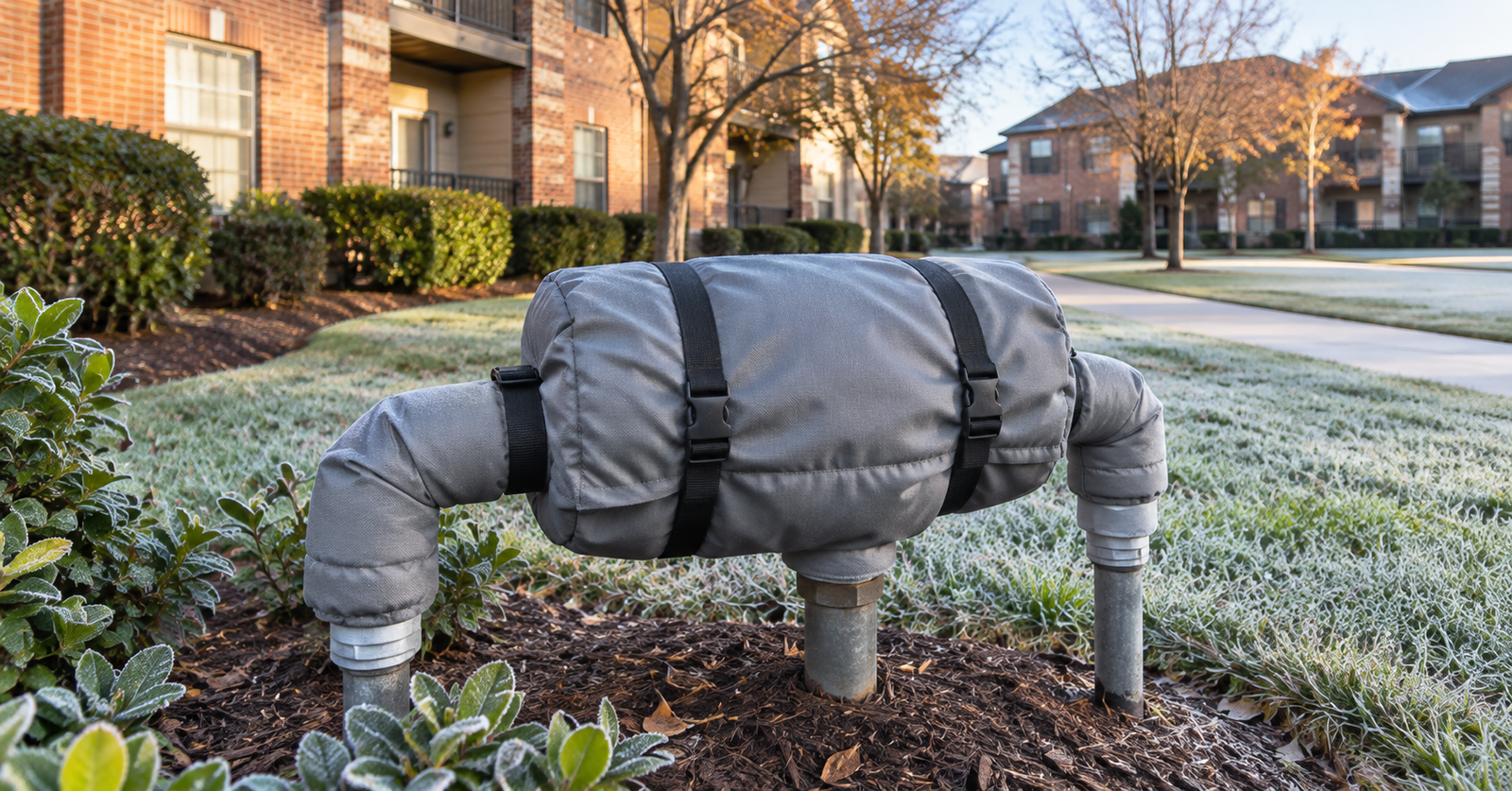
  • Irrigation systems. Above-ground backflow preventers are the single most-damaged exterior fixture during DFW freezes. A $600 backflow can become a $6,000 repair plus water damage.
  • Pool equipment rooms, laundry rooms, maintenance buildings. Spaces with plumbing but limited heating.
  • Clubhouse, leasing office, amenity buildings. Restrooms, kitchenettes, mechanical closets.
  • Mechanical rooms and utility closets. Check pipe insulation condition and verify heating is functional.
  • Main building shutoff valve access. If the valve is behind a locked gate nobody has the key to at 2 a.m., it’s not accessible.
Vulnerability map template. Build one per building, not one per property.
Building / Location Issue Action required Assigned Deadline Status
Bldg 3, Unit 312 (vacant) Exterior-wall plumbing, no heat Set thermostat to 60°F, verify utilities [name] Nov 15
Bldg 7 breezeway Exposed hose bib Insulate, install cover, disconnect hose [name] Nov 15
Irrigation zone 4 Exposed backflow preventer Winterize, insulate, confirm shutoff [name] Nov 17

Most properties think they have a list. Most properties actually have a general idea. The difference matters when a Freeze Warning drops on Saturday night and a maintenance tech needs to know exactly which 14 locations to check first.

Step 2: Complete the preventive maintenance tasks

Work through the vulnerability map in order of risk. Six categories of tasks, each assigned to a named technician with a completion deadline.

Exposed plumbing

Insulate pipes in exterior walls, unheated spaces, and breezeways. Replace damaged insulation rather than patching it. Pay particular attention to plumbing that runs through unconditioned space to reach units — these are the lines most likely to freeze even when the unit itself is heated.

Exterior faucets and hose bibs

Disconnect and store garden hoses. Install faucet covers. Check for drips or seal failures. An exterior faucet left connected to a hose is one of the easier failure modes to prevent and one of the most common to overlook.

Heating systems

Confirm every clubhouse, leasing office, mechanical room, and amenity building has functional heat. Verify thermostats in vacant units are set to a minimum temperature — 55 to 60°F is the common guideline, but defer to your property policy. Identify any space where a heating failure would expose plumbing.

Irrigation systems

Schedule professional winterization of the irrigation system including blow-out of underground lines where applicable. Protect exposed backflow preventers with proper covers or insulation. Confirm the irrigation shutoff location is documented and accessible.

Vacant units

Inspect every vacant unit. Confirm utilities are active or that heat is being maintained some other way. Flag any vacant unit with plumbing against an exterior wall for a dedicated inspection cycle during active freeze events.

Shutoff valve access

Locate every main building shutoff. Confirm maintenance personnel can access each one at night, in the rain, in freezing temperatures. Label unmarked valves. Verify after-hours maintenance staff know where the keys are.

Step 3: Build the team and vendor readiness plan

Equipment is half the job. The other half is operational — who does what, when, and with which vendor on speed dial.

Freeze-prep responsibility matrix. Assign every item to a named owner, not a role.
Responsibility Owner
Building-by-building plumbing inspection Maintenance supervisor
Vacant unit verification Maintenance tech, assigned by building
Irrigation winterization Grounds vendor or maintenance
Resident notifications Property manager
Emergency plumber contact confirmation Property manager
Restoration vendor standby Property manager
Supply inventory check Maintenance supervisor
After-hours on-call schedule Property manager
48-hour final verification Property manager + supervisor

Confirm your emergency plumber and water-mitigation vendor are available and know the property. A plumber who’s never been to your community will spend 20 minutes finding the building at 3 a.m. — 20 minutes that materially affects the damage estimate.

Supply inventory to verify before the first freeze: pipe insulation, foam faucet covers, heat tape, absorbent materials, buckets, wet-dry vacuum access, flashlights, batteries, and the keys to every mechanical room on property.

Step 4: Resident communications

Residents are the lowest-cost, highest-leverage line of defense you have. A resident who reports a dripping ceiling at 11 p.m. instead of 7 a.m. is the difference between a wet carpet and a replaced subfloor.

Communication to prepare before the season starts:

  • Expected notification timing before a freeze — a day or two of lead time, not a surprise text at midnight.
  • Property-approved guidance on in-unit preparation — follow your property policy on dripping faucets, cabinet doors, and thermostat settings rather than universal advice that may not fit your plumbing configuration.
  • What residents should do if water stops flowing or a leak develops.
  • The after-hours emergency maintenance phone number, in writing, in the unit.
  • How to report a heating failure immediately, not wait until morning.

Use multiple channels — email, resident portal, SMS, community signage, door hangers for communities where that fits the demographic. Build the resident freeze notification as a reusable template now so sending it during an actual event takes five minutes.

The 48-hour pre-freeze readiness check

Run this when NWS Fort Worth issues a Freeze Watch, or roughly 48 hours before expected freezing conditions. The point is verification, not first-time inspection — if you’re doing the inspection work during this check, your preparation started too late.

A. Maintenance verification

  • ☐ All identified exposed plumbing inspected and insulated
  • ☐ Damaged or missing pipe insulation replaced
  • ☐ Exterior faucets disconnected, covered, verified
  • ☐ All vacant units inspected, heat confirmed where required
  • ☐ Heating systems operational in clubhouse, amenity buildings, mechanical rooms
  • ☐ Irrigation system winterized, backflow preventers protected
  • ☐ Main building shutoff valves located, accessible, keys available
  • ☐ Common-area plumbing checked (pool equipment, laundry, maintenance buildings)

B. Team and vendor readiness

  • ☐ On-call maintenance schedule confirmed with named coverage
  • ☐ Emergency plumber contact confirmed, hours and availability verified
  • ☐ Restoration vendor on standby, contact information posted
  • ☐ Emergency supplies stocked and staged
  • ☐ Building assignments distributed to maintenance team
  • ☐ Escalation path documented and understood

C. Resident and management communication

  • ☐ Resident freeze notification sent via email, SMS, portal
  • ☐ Emergency reporting instructions available at the leasing office and online
  • ☐ Regional manager notified of readiness status
  • ☐ Any outstanding critical issue flagged to regional management

Finish the check with a property-wide walkthrough by the property manager and the maintenance supervisor together, and a documented status:

  • Green: All critical items complete. Property is ready.
  • Yellow: Minor outstanding items with assigned owners and completion deadlines before the freeze event.
  • Red: Critical vulnerabilities remain. Escalate to regional immediately with a specific remediation plan and timeline.

From preparation to active response

When freezing conditions arrive, the operational posture changes. Inspections run on a cycle rather than one-time. Maintenance response times tighten. The property manager monitors forecasts, vulnerability map hot spots, and incoming reports in parallel.

Core active-freeze operations:

  • Scheduled inspection cycles of mapped vulnerability points — not single pass-throughs
  • Immediate response to any heating failure or reduced-flow report
  • Documented emergency shutoff procedures if a leak is found
  • Incident log with time stamps, action taken, and resident communication record
  • Escalation to regional management for any significant water intrusion

Safety note that doesn’t need to be a footnote: maintenance staff should never use open flames or improvised heating methods to thaw frozen pipes. The property damage from a thaw-caused fire is substantially worse than the damage from a burst pipe. Use approved methods only, or wait for the plumber.

Make it a routine, not a response

The properties that get through February without emergency calls aren’t the ones with warmer weather. They’re the ones running this process every year, updating the vulnerability map every November, and treating freeze preparation as a recurring operational cycle rather than a weather-triggered scramble. If you need help building the vulnerability map for your property or want a grounds vendor who handles irrigation winterization as part of the regular scope, our grounds and common-area team works across the DFW metroplex. For questions on how freeze prep fits inside a broader 2027 property services budget, our budget framework piece covers which maintenance cuts save money versus which ones migrate the cost to next year’s water damage line.

For tenant move-out situations, see our trash-out checklist for property managers.

For valet trash pricing details, see our valet trash pricing guide for DFW.

Need help running freeze prep across your DFW portfolio?

Verdant provides grounds, common-area, and maintenance support across the Dallas–Fort Worth metroplex. If you’re one maintenance tech short of running this checklist across every property before Thanksgiving, we can walk your communities, build the vulnerability map, and handle irrigation winterization alongside your in-house team.

Request a quote or call 888-520-0340.
Services

Where to Cut Property Services Spend in Your 2027 Budget — and Where Not To

Not every property-services cut saves money. Some cuts just move the cost to a different line item. The 2027 cuts that actually reduce spend are supplier consolidation, over-scoped specifications, and bundled extras hiding in recurring contracts. The cuts that look like savings but migrate the cost elsewhere — reducing porter frequency, cutting valet trash entirely, deferring paint, dropping common area cleaning — show up again in retention, make-ready costs, and leasing velocity within twelve months. This piece separates the two and gives you a framework your finance team will defend.

Written for the regional manager building a DFW multifamily budget right now. Budget season closes in late October, so the question isn’t whether to cut — it’s whether to cut intelligently or reflexively. Reflexive cuts produce the budget conversations managers have in April about why Q1 numbers didn’t improve.

Why does this matter in 2027 specifically?

Three forces are converging. CoStar’s 2027 forecast puts multifamily vacancy around 8.4–8.8% nationally, with Sun Belt markets including DFW expected to recover more slowly than the national average. Multi-Housing News reported in September that operators are explicitly reviewing waste and trash contracts as savings targets. And rent growth projections remain modest, which puts the pressure on operating cost rather than top-line revenue.

In plain terms: your regional VP is asking you to find money on the expense side because the revenue side isn’t going to deliver it. That ask is reasonable. The response that works is a surgical one, not a uniform percentage reduction.

What’s the test for a real cut versus a migrating cost?

Three questions, applied to every proposed cut before it goes in the budget.

Does the saved cost reappear somewhere else within twelve months? If cutting a service means more make-ready work, more turn cost, more trash-out jobs, or more hauler emergency pickups, the cut isn’t a cut. It’s a transfer with an administrative handling fee attached.

Does the cut change what residents see? If the first noticeable change happens at the trash chute, the dumpster, the corridor floor, or the leasing office tour route, you’re on a path to lower renewals. Retention is more expensive than most line items you’d save on.

Does the cut increase your per-unit turn cost? Deferred paint, deferred carpet, deferred appliance replacement, deferred common area touch-ups — all of these look like savings in the current year and arrive as larger numbers in the make-ready budget six to twelve months later.

If a proposed cut survives all three questions, it’s a real cut. If any one of them is a yes, you’re moving money between buckets.

Where the real cuts live

Six places. In order of how much they typically save without migration.

1. Vendor consolidation

Most DFW portfolios run five to seven separate vendors for property services: one for valet trash, one for common area cleaning, one for grounds, one for painting, one for carpet, one for make-ready, sometimes a separate one for trash-out. Each vendor carries its own admin overhead, its own invoicing, its own account manager, and its own markup on anything bundled.

Consolidating to two or three multi-service vendors typically produces 8–15% savings on the combined spend, without touching service frequency or quality. The savings come from the vendor’s reduced coordination cost, not from reduced labor. This is the single largest line-item opportunity in most 2027 budgets.

2. Over-scoped contract specifications

Pull your valet trash contract and read the scope. Then pull the actual service you receive. In many portfolios, the contract specifies seven-nights-a-week pickup on a property that only generates enough volume for five nights. Or it specifies bin replacement intervals that haven’t been triggered in two years. Or it bundles recycling collection that your city has since stopped accepting.

Right-sizing the specification to what you actually need, rather than renegotiating the rate, often produces 10–20% savings on the recurring line without changing what residents experience. Our valet trash pricing guide covers which contract terms move the number most.

3. Bundled extras hiding in recurring contracts

Signage, bin replacement, resident compliance materials, holiday schedule adjustments — these appear as “included” in a lot of recurring contracts and as separate line items in a lot of others. If you’re paying for them twice, or paying for one you’ve never used, that’s a cut with no downstream cost.

4. Service frequency on genuinely under-used scopes

Different from reducing frequency to meet a budget target. The question here is whether your current frequency reflects current occupancy and traffic. A 150-unit property that was at 94% occupancy when the contract was signed and is now at 78% doesn’t need the same porter schedule. A common area cleaning scope written for a 240-unit property that recently sold off a 60-unit building has excess capacity in it.

This cut only works when the reduction tracks actual utilization. Reducing frequency because the budget demands it, rather than because the usage has dropped, is a migrating cost, not a real one.

5. Reactive maintenance driven by root causes you haven’t fixed

If the same unit, same building, or same system generates recurring work orders, you’re paying three or four times to not solve the underlying problem. Spending 60% of the annual repair budget on recurring issues at 10% of the units is a pattern most portfolios have and few address directly.

Fixing the root cause in a planned maintenance pass usually costs less in year one than the reactive work orders it replaces. The savings compound in years two and three.

6. Trash-out volume you’re paying for twice

Properties with high turnover often run both a general trash-out contract and bulk hauling, with overlapping scope. The vendor shows up for an evicted unit’s cleanout, and the hauler shows up two days later for the dumpster the cleanout filled. Both are billed. The second one is often avoidable if the trash-out scope includes direct hauler coordination.

Where the cuts migrate (so don’t make them)

Four cuts that produce savings on the spreadsheet and larger costs somewhere else.

Cuts that look like savings but migrate cost to a different line item within 12 months.
Proposed cut Where the cost actually goes Typical timeline
Reduce porter frequency Resident complaints, lower renewals, worse Google reviews, higher leasing concessions. The labor you saved reappears in the lost rent on the units you couldn’t retain. 3–9 months to see it in retention data
Cut valet trash entirely Dumpster hauler emergency pickups, maintenance labor for corridor cleanup, resident reviews about trash buildup, lost amenity-fee revenue. Our piece on resident compliance covers why cutting the service often costs more than fixing it. 60–120 days to appear in hauler invoices
Defer paint and cosmetic touch-up Larger make-ready at turn, longer vacancy between residents, and increased add-on paint cost per unit. The current-year savings becomes next-year’s inflated turn budget. Hits whenever the unit next turns, which averages 6–18 months
Reduce common area cleaning Lower tour-to-lease conversion rate on the next 90 days of leads. Prospects notice. Even without named complaints, your closing rate drops 5–15%. Measurable in the next quarter’s leasing report

Each of these looks like a line-item savings and is one, in isolation. The cost shows up in a different line that doesn’t get connected back to the cut in next year’s budget review. Which is why these cuts keep getting made.

The framework to run against every proposed cut

Four questions, in order. If a proposed cut fails any of them, it’s a cost transfer rather than a saving.

  1. Where does this cost reappear? Make-ready, hauler, maintenance, retention, concessions, legal. Name the line.
  2. What’s the time horizon? If the migrated cost shows up within the same budget year, the cut is false. If it shows up in year two or three, decide whether you’re kicking the can intentionally or by accident.
  3. Who in the organization sees the migrated cost? If the cut you’re approving shows up as a problem for a different department (make-ready, leasing, maintenance), that department should sign off on the cut. If they won’t, you’ve found the real reason the cut shouldn’t happen.
  4. Can the vendor restructure the service rather than cutting it? A frequency change, a scope right-sizing, a billing-basis switch, or a consolidation often produces the same savings without the downstream cost. Ask before cutting.

What this looks like applied

Consider a 240-unit DFW garden community, stabilized at 89% occupancy, running separate contracts for valet trash, common area cleaning, grounds, make-ready, carpet, and painting. 2027 budget guidance says reduce property services spend by 8%.

The reflexive cut: trim 8% off each vendor rate and tell them to make it work.

The surgical approach: consolidate the six vendors into two, saving 10–12% on combined overhead. Right-size the valet trash scope from seven nights to five based on actual volume. Review the common area contract against the current occupancy. Audit the make-ready scope for over-specification. The combined result typically hits 10–15% savings rather than 8%, without visible service degradation.

The difference between the two approaches is what gets reported at Q2. The first produces complaints, missed renewals, and a conversation about why operating cost didn’t improve despite the cuts. The second produces a smaller invoice and a quieter quarter.

What to do before budgets are approved

Three steps, this week.

Pull last year’s actual spend by service category. Not budget, actual. Compare to the previous year. The categories where actual exceeded budget are candidates for scope review, not for rate cuts.

Classify every service. Protect (safety, compliance, legally required), Optimize (adjustable scope or frequency), or Challenge (duplicated, overlapping, or over-specified). The Challenge category is where the real cuts live. The Protect category is where cuts become next year’s problem.

Talk to your top vendors before you decide. Any reasonable vendor can tell you where their own scope has room to right-size versus where cutting creates downstream issues. The vendors who can’t have a conversation at this level are the ones to replace at renewal.

For move-out situations, see our tenant move-out trash-out checklist for property managers.

Reviewing your 2027 property services budget?

Verdant provides consolidated valet trash, trash-out, make-ready, common area cleaning, and grounds services across the Dallas–Fort Worth metroplex. If you’re trying to reduce spend without migrating costs, we can walk through your current scope and identify what’s cuttable versus what’s masking as a cut.

Request a quote or call 888-520-0340.

Cleaning Services

Professional Painting Services: Transforming Your Space in Dallas

A fresh coat of paint can do wonders, breathing new life into any room or building. Whether it’s a residential home or a commercial establishment, the impact of well-executed painting is both immediate and long-lasting. In a fast-growing city like Dallas, where the appearance of properties significantly influences their value and the comfort of those who inhabit them, investing in a beautiful and well-maintained facade is essential. To achieve the best possible outcomes, hiring skilled painting professionals becomes indispensable. Their expertise ensures not only aesthetic appeal but also the durability and value of the property.

Why Hiring a Professional Painting Team Matters

Professional painting teams bring a wealth of expertise to the table. They excel in surface preparation, ensuring that walls and ceilings are primed to perfection. Their proficiency in color matching guarantees that the chosen shades complement the overall design theme, delivering long-lasting finishes that withstand the test of time. Moreover, they have access to premium tools, top-tier paint products, and specialized techniques that an amateur may lack.

The benefits extend beyond just aesthetic enhancements. Hiring professionals means significant time savings and enhanced safety. Their training equips them to handle projects efficiently, minimizing disruptions and ensuring a safer environment. Choosing a Professional Painting Service ensures flawless results and long-term durability, offering peace of mind knowing that the investment in your property is well protected.

How Professional Painters Transform Homes & Businesses

Professional painters play a pivotal role in transforming both homes and businesses, making spaces more inviting and functional.

Interior Painting

Interior painting is a simple yet effective way to refresh walls, ceilings, trim, and feature areas. A professional touch can bring out the beauty in architectural details and enhance the mood of a space. By selecting the right colors and finishes, professional painters can create an ambiance that reflects the personality and purpose of the room, whether it’s a cozy living area or a vibrant office space.

Exterior Painting

The exterior of a building is the first impression visitors and passersby have. Professional painters can significantly boost curb appeal while also providing a protective layer against harsh Dallas weather conditions. High-quality exterior paint not only beautifies but also shields the structure from elements like UV rays, rain, and wind, extending the lifespan of the property’s exterior.

Commercial Painting

For businesses, a polished, professional environment is crucial for both employees and customers. Professional painters understand the unique needs of commercial spaces, from retail shops to office buildings. A fresh coat of paint can create a welcoming atmosphere, enhance brand identity, and even improve employee morale and productivity. Attention to detail and an understanding of commercial design principles allow for a seamless transformation that aligns with business goals.

Color Consultation

Color plays a vital role in defining spaces. Professional painters often provide expert color consultation to help clients choose modern, cohesive palettes that suit their style and functional needs. Whether it’s adopting modern neutrals, earth tones, or bold accent walls, their guidance ensures that the chosen colors enhance the space’s purpose and aesthetic.

Detailed Preparation & Cleanup

One of the hallmarks of professional painting services is meticulous preparation and cleanup. This attention to detail ensures smooth finishes and a clean workspace, leaving the property in perfect condition. From protecting furniture to cleaning up paint splatters, professional painters handle it all, allowing property owners to enjoy the transformation without the hassle.

Real-World Examples

Consider a Dallas homeowner looking to revitalize their living room. With the help of a professional painting service, they choose a serene blue-gray palette that complements their modern furnishings, transforming the room into a tranquil retreat.

For a local retail space, a fresh and vibrant color scheme can attract more customers and enhance their shopping experience. Professional painters can execute these transformations efficiently, minimizing downtime and maximizing impact.

Why Local Expertise Matters in Dallas

Local expertise is invaluable when it comes to painting in Dallas. Understanding the unique characteristics of local building materials, climate conditions, and neighborhood aesthetics is crucial. A seasoned local painter knows the trends popular in the Dallas market, such as modern neutrals, earth tones, and bold accent walls, and can offer tailored solutions that match local expectations.

Choosing a Painting Service Dallas provider ensures that the project reflects the unique charm and style of the area while meeting the practical demands of the local environment. This local knowledge, combined with professional skills, results in a transformation that resonates with the community and enhances property value.

How to Choose the Right Painting Company

Selecting the right painting company involves several key considerations:

  • Check Licensing and Insurance: Ensure the company is licensed and insured, protecting you and your investment.
  • Review Before-and-After Photos and Customer Testimonials: Look at their portfolio and read reviews to gauge their quality and reliability.
  • Compare Quotes, Timelines, and Detailed Scopes of Work: Obtain multiple quotes to compare costs and ensure they fit your budget and schedule.
  • Ask About Warranties, Prep Processes, and Paint Quality: Inquire about guarantees, their preparation methods, and the quality of paint they use to ensure long-lasting results.

Conclusion

Professional painters deliver exceptional transformations for both homes and businesses. Their expertise and local knowledge are invaluable in a city like Dallas, where property aesthetics play a significant role in value and comfort. By choosing local experts familiar with the area, Dallas residents can achieve superior results that enhance their properties’ appeal and longevity. If you’re considering an upgrade, explore trusted painting professionals to bring your vision to life and elevate your space to new heights of beauty and functionality.

Cleaning Housekeeper Services

Why the Best Property Management Services Are Needed in 2023

Owning rental properties can be a great way to generate passive income. However, it can also be a lot of work, especially if you don’t have the time or expertise to manage your properties yourself. This is where property management services come in.

Property management services can handle all aspects of managing your rental properties, from finding tenants to collecting rent to handling maintenance requests. This frees you up to focus on other things, such as your day job or your family.

But not all property management companies are created equal. Some are more experienced and reliable than others. So why are the best property management services needed in 2023?

Here are a few reasons
  • The rental market is becoming more competitive.
    In today’s competitive rental market, it’s more important than ever to have a professional property manager who can help you market your properties effectively and attract the best tenants.
  • The laws and regulations governing rental properties are constantly changing.
    It can be difficult to keep up with all the latest changes, which is why it’s important to have a property manager who can stay up-to-date on the latest laws and regulations.
  • The cost of owning rental properties is rising.
    The cost of everything from property taxes to insurance is rising, which means that it’s more important than ever to have a property manager who can help you keep your costs under control.
  • The demand for property management services is increasing.
    As more and more people become landlords, the demand for property management services is increasing. This means that there is more competition for the best property management companies, which is good news for you as a landlord.
If you’re considering hiring a property management company, there are a few things you should keep in mind:
  • Do your research.
    Before you hire any property management company, be sure to do your research. Read online reviews, check with the Better Business Bureau, and ask for referrals from other landlords.
  • Ask the right questions.
    Once you’ve narrowed down your options, be sure to ask the property management companies you’re considering the right questions. This will help you assess their experience, expertise, and fees.
  • Get everything in writing.
    Once you’ve chosen a property management company, be sure to get everything in writing. This includes the terms of the contract, the fees, and the services that will be provided.

    By following these tips, you can be sure to find a top-rated property management company that can help you manage your rental properties and achieve your financial goals.

Here are some additional benefits of using the best property management services in 2023
  • Peace of mind
    When you hire a property management company, you can rest assured that your properties are in good hands. The company will handle all the day-to-day tasks of managing your properties, so you can focus on other things. 
  • Increased profitability.
    A good property management company can help you increase your profitability by finding the best tenants, collecting rent on time, and handling maintenance requests promptly. 
  • Reduced stress.
    Managing rental properties can be stressful, but hiring a property management company can help you reduce your stress levels. You can focus on other things, knowing that your properties are in good hands. 

About Verdant Building Services

Verdant Building Services is a full-service property management company that offers a wide range of services, including valet trash, groundskeeping, housekeeping, light handy work, trash outs, and make readies. We have over 50 years of combined experience in property management, building services, and building maintenance. We are experts in managing rental properties in the DFW area, and we have a proven track record of success.

If you’re looking for top-rated property management services, Verdant Building Services is the perfect choice for you. We offer the highest level of service, and we are committed to providing our clients with the best possible experience. Contact us today to learn more about our services and how we can help you manage your rental properties.

 
Cleaning Services

Valet Trash is invaulable to residents and manager.

Valet trash as a service is a convenient and efficient way to dispose of trash and recycling in apartment buildings, condominiums, and other multi-unit properties. With valet trash, residents place their trash in designated containers outside their doors, and the valet trash company will pick it up and dispose of it properly.
There are many benefits to valet trash service, both for property owners and residents. For property owners, valet trash can help to
    • Improve property value
    • Reduce pests
    • Create a more sanitary environment
    • Reduce liability
    • Save time and money
  • For residents, valet trash can help to:
    • Make trash disposal more convenient
    • Reduce the spread of pests
    • Improve the overall cleanliness of the property
    • Free up time for other activities
    • How Valet Trash Works

  • Valet trash service typically works like this
    Residents place their trash and recycling in designated containers outside their doors.

    A valet trash company picks up the trash and recycling and transports it to a disposal facility.

    The trash and recycling is disposed of properly.

    The frequency of trash and recycling pickup can vary depending on the needs of the property. Some properties have trash and recycling picked up daily, while others have it picked up weekly or even monthly.

The Benefits of Valet Trash for Property Owners
  • There are many benefits to valet trash service for property owners, including
    Convenient trash disposal: Residents do not have to worry about hauling trash and recycling to the dumpster or recycling bin. They simply place their trash and recycling in designated containers outside their doors, and a valet trash company will pick it up and dispose of it properly.
  • Reduced spread of pests
    Trash and recycling can attract pests, such as rodents and insects. Valet trash service can help to reduce the presence of pests, which can improve the overall health and safety of the property.
  • Improved cleanliness
    A clean and well-maintained property is more appealing to residents. Valet trash service can help to create a more sanitary environment by removing trash and recycling promptly.
    Freed up time: Residents can save time by not having to worry about trash and recycling disposal. They can use this time for other activities, such as spending time with their families or pursuing their hobbies.

How to Choose a Valet Trash Service

If you are considering valet trash service for your property, there are a few things you should keep in mind when choosing a company

  • Cost
    Valet trash service can vary in cost depending on the frequency of pickup, the size of the property, and the location of the property. 
  • Level of service
    Some valet trash companies offer a higher level of service than others. Be sure to ask about the specific services that are offered by each company.
  • Availability
    Not all valet trash companies are available in all areas. Be sure to check with the company to see if they offer service in your area.
  • Conclusion
    Valet trash service is a convenient and efficient way to dispose of trash and recycling in apartment buildings, condominiums, and other multi-unit properties. There are many benefits to valet trash service, both for property owners and residents. If you are considering valet trash service for your property, be sure to do your research and choose a company that offers a high level of service and is available in your area.

About Verdant Building Services

Verdant Building Services is a full-service property management company that offers a wide range of services, including valet trash, groundskeeping, housekeeping, light handy work, trash outs, and make readies. We have over 50 years of combined experience in property management, building services, and building maintenance. We are experts in managing rental properties in the DFW area, and we have a proven track record of success.

If you’re looking for top-rated property management services, Verdant Building Services is the perfect choice for you. We offer the highest level of service, and we are committed to providing our clients with the best possible experience. Contact us today to learn more about our services and how we can help you manage your rental properties.

 
Services

The Top 5 Mistakes Property Managers Make When Hiring Service Providers

As a property manager, you know that your success depends on hiring the right service providers. But with so many companies out there, it can be easy to make mistakes.

In this blog post, we will discuss the top 5 mistakes property managers make when hiring service providers. We will also provide tips on how to avoid these mistakes and hire the right providers for your needs.

  • Mistake #1: Not doing their research
    One of the biggest mistakes property managers make is not doing their research before hiring a service provider. This can lead to hiring a company that is not qualified or experienced, or that does not offer the services you need.
    To avoid this mistake, be sure to do your research before hiring any company. This includes reading online reviews, checking with the Better Business Bureau, and asking for referrals from other property managers.
  • Mistake #2: Not getting everything in writing
    Another common mistake is not getting everything in writing when hiring a service provider. This can lead to misunderstandings and disputes down the road.
    Make sure to get everything in writing, including the terms of the contract, the fees, and the services that will be provided. This will protect you in case there are any problems.
  • Mistake #3: Hiring the cheapest option
    It can be tempting to hire the cheapest option when hiring a service provider. However, this is often a mistake.
    In some cases, the cheapest option may not be the best option. It is important to consider the quality of the services, the experience of the company, and the company’s reputation before making a decision.
  • Mistake #4: Not communicating effectively
    Communication is key when working with service providers. If you do not communicate effectively, it can lead to problems down the road.
    Be sure to communicate your expectations clearly to the service provider. This includes the services you need, the timeline for the work, and your budget.
  • Mistake #5: Not following up
    Once you have hired a service provider, it is important to follow up to make sure that the work is being done to your satisfaction. This includes checking in with the service provider regularly to see how the work is progressing. It also includes addressing any problems or concerns that you may have.
  • How to Avoid These Mistakes
    By avoiding these mistakes, you can increase your chances of hiring the right service providers for your needs.
    Here are some tips on how to avoid these mistakes:
    Do your research before hiring any company.
    Get everything in writing.
    Do not hire the cheapest option.
    Communicate effectively with the service provider.
    Follow up regularly to make sure that the work is being done to your satisfaction.
    Conclusion
    Hiring the right service providers is essential for the success of any property management business. By avoiding these common mistakes, you can increase your chances of hiring the right providers for your needs.
  • Hire a new company when you’ve tried everything else
    If you’re not happy with the services you’re receiving, don’t be afraid to change companies. There are plenty of great property management companies out there, so you shouldn’t have to settle for one that’s not meeting your needs.
  • Conclusion
    Finding top-rated property management services can be a daunting task, but it’s important to do your research and find a company that you can trust. By following these tips, you can be sure to find a company that will help you succeed in your property management business.

About Verdant Building Services

Verdant Building Services is a full-service property management company that offers a wide range of services, including valet trash, groundskeeping, housekeeping, light handy work, trash outs, and make readies. We have over 50 years of combined experience in property management, building services, and building maintenance. We are experts in managing rental properties in the DFW area, and we have a proven track record of success.

If you’re looking for top-rated property management services, Verdant Building Services is the perfect choice for you. We offer the highest level of service, and we are committed to providing our clients with the best possible experience. Contact us today to learn more about our services and how we can help you manage your rental properties.

 
Services

Identify Top-Rated Property Management Services in 10 Easy Steps

As a property manager, your success depends on finding top-rated property management services that will complete the job on time and on budget. Here are 10 essential steps for finding top-rated property management services:
  • Request referrals from other property managers in your area.
    Get recommendations from local experts like real estate professionals, and other property managers in your area. This is a great way to get unbiased feedback from people who have experience working with different companies.
  • Conduct online research to compare prices and read reviews of different companies.
    Read reviews and compare prices on different companies. You can find reviews on websites such as Google, Yelp, and Angie’s List. You can also compare prices on websites like HomeAdvisor and Thumbtack.
  • Clearly define your scope of work and communicate them clearly
    When you’re looking for property management services, it critical to define the scope of work for each project. Your expectations from the provider and any additional details you may need the provider.
  • Negotiate for better pricing.
    Once you’ve found companies that you’re interested in, negotiate. Service providers are incentivized to secure your business.
  • Getting everything in writing is essential.
    Once you’ve chosen a company, it is essential to get everything in writing. We recommend countersigned docs from authorized personal in each company. The document must include all terms, fees, and services that will be provided. It is imperative that you consult your legal, business, and financial professionals prior to signing any documents.
  • Follow up.
    Once you’ve started working with a company, be sure to follow up regularly. This will help you ensure that the company is meeting your expectations.
  • Hire a new company when you’ve tried everything else
    If you’re not happy with the services you’re receiving, don’t be afraid to change companies. There are plenty of great property management companies out there, so you shouldn’t have to settle for one that’s not meeting your needs.
  • Conclusion
    Finding top-rated property management services can be a daunting task, but it’s important to do your research and find a company that you can trust. By following these tips, you can be sure to find a company that will help you succeed in your property management business.

About Verdant Building Services

Verdant Building Services is a full-service property management company that offers a wide range of services, including valet trash, groundskeeping, housekeeping, light handy work, trash outs, and make readies. We have over 50 years of combined experience in property management, building services, and building maintenance. We are experts in managing rental properties in the DFW area, and we have a proven track record of success.

If you’re looking for top-rated property management services, Verdant Building Services is the perfect choice for you. We offer the highest level of service, and we are committed to providing our clients with the best possible experience. Contact us today to learn more about our services and how we can help you manage your rental properties.